Dorval and the West Island · Tiohtià:ke
Eco de l’OuestLow-mow lawns and eco gardens Book a consult
← All plants
Sugar maple

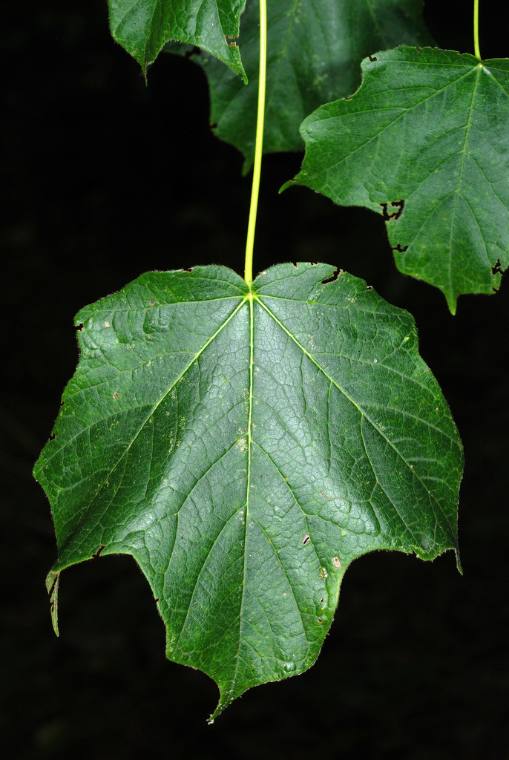
Photo: Douglas Goldman, CC BY-SA 4.0, via iNaturalist · Jefferson County, WV, USA, 2016-07-15

Trees · Native to Quebec

Sugar maple

Acer saccharum Sapindaceae

Sugar maple is a large, long-lived deciduous tree with a dense rounded crown and five-lobed leaves up to 20 cm across. Bark is smooth on young trees and becomes shaggy and furrowed with age. Small greenish-yellow flowers open in spring as the leaves emerge, followed by paired winged seeds in late summer. Autumn colour ranges from bright yellow through orange to red-orange.

Latin
Acer saccharum
Marshall · family Sapindaceae · also Acer saccharophorum K. Koch
English
Sugar maple
hard maple, rock maple
French
Érable à sucre
érable franc
Kanien'kéha (Mohawk)
wáhta'
ohwáhta
Spelling as given by the Greenbelt Indigenous Botanical Survey page for sugar, red and silver maple, which lists both forms for sugar maple.
Anishinaabemowin (Ojibwe)
ininaatig
ininaatik, aninaatig
Ojibwe People's Dictionary glosses ininaatig as 'a maple' (sugar maple, Acer saccharum); it is an animate noun with plural ininaatigoog. The Greenbelt survey writes the name as ininaatik and ininaatig. Aninaatig has the same gloss in the dictionary.

Through the year

Sugar maple in every season.

Story

The history of sugar maple.

Sugar maple is native to eastern Canada and the northeastern United States, and is a dominant tree of the hardwood forests of southern Quebec. It prefers rich, moist, well-drained soils and is sensitive to road salt, drought-driven leaf scorch and soil acidification. It is the main source of maple syrup, and the species is listed as Least Concern by the IUCN.

The epithet saccharum refers to sugar. The species was described by Humphry Marshall in 1785. Haudenosaunee and Anishinaabe communities have long treated maples as important trees, the first to wake when sap begins to run in late winter, and sugar and syrup are central to their stories. The hard wood is used for furniture, flooring, musical instruments and bowling alley lanes.

Sources: Wikipedia: Acer saccharum · Lady Bird Johnson Wildflower Center: Acer saccharum · Greenbelt Indigenous Botanical Survey: Sugar Maple, Red Maple, and Silver Maple · VASCAN: Acer saccharum

Characteristics

The plant at a glance.

Height25 to 35 m at maturity; slow growing
Spread12 to 18 m
HabitUpright tree with a dense, rounded crown
Bloom timeApril to May
FlowersSmall greenish-yellow flowers in drooping clusters
FoliageFive-lobed leaves up to 20 cm across; yellow, orange and red-orange in fall
FruitPaired winged samaras ripening in late summer to fall
HardinessZone 3
LightFull sun to full shade
MoistureMedium; prefers rich, well-drained soil
Spread behaviourSingle trunk; self-sows freely under the tree
Native rangeNewfoundland south through the mountains to Georgia, west to Minnesota and eastern Kansas
Quebec statusNative

In the Flight Path Garden

Where it grows here.

ZonesMini-Forest
How many1
Planted2026

In the back row of the Mini-Forest it is the long-term canopy tree that will eventually shade the layers beneath it. Its leaves build deep leaf litter and its flowers feed early bees.

Wildlife

Who uses it.

  • Flowers are of special value to honey bees and other early-season pollinators.
  • Attracts birds, which use the tree for cover, nesting and seeds.
  • Dense shade and heavy leaf litter support a woodland floor community beneath the tree.

Sources: Lady Bird Johnson Wildflower Center: Acer saccharum

Care

What to do, season by season.

Spring

Water a young tree weekly in dry weather and keep a mulch ring clear of the trunk. Leave the lower branches that form naturally.

Summer

Water deeply during dry spells, since drought causes leaf scorch. Avoid compacting the soil over the roots.

Fall

Leave the fallen leaves under the tree as mulch. Water well before freeze-up in the first few years.

Winter

Keep the tree away from road salt and snow-clearing runoff. Mark small trees so they are not hit by shovels or plows.

Relations

Knowledge and use.

The Greenbelt Indigenous Botanical Survey notes that maples hold deep importance for Haudenosaunee and Anishinaabe communities, as the first trees to wake when sap runs in winter. Syrup and sugar appear in their stories, and hard maples such as sugar maple are valued for corn bread and soup spoons that do not crack in liquid, and for timber construction.

Source: Greenbelt Indigenous Botanical Survey: Sugar Maple, Red Maple, and Silver Maple