Dorval and the West Island · Tiohtià:ke
Eco de l’OuestLow-mow lawns and eco gardens Book a consult
← All plants
Yarrow

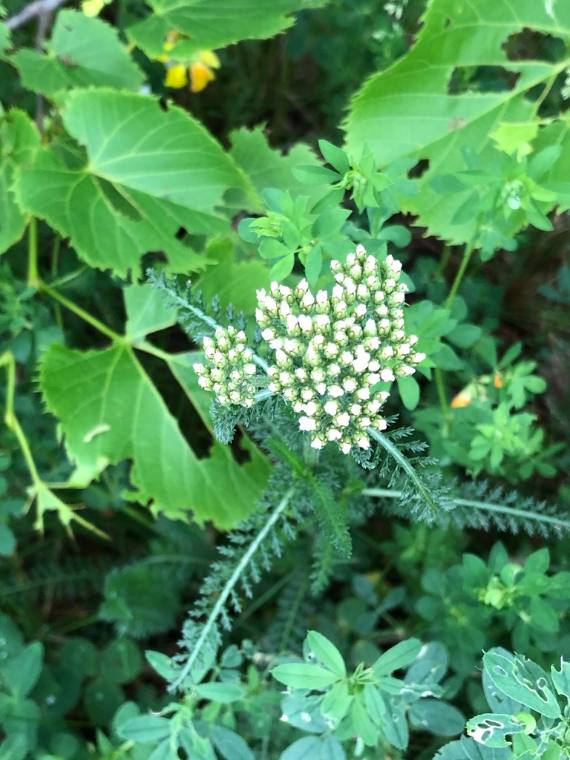
Photo: Andrew Sebastian, CC BY 4.0, via iNaturalist · Oak Ridges Trail, Richmond Hill, ON, CA, 2021-06-08

Flowers and groundcovers · Native to Quebec

Yarrow

Achillea millefolium Asteraceae

Yarrow is a tough perennial with finely divided, feathery, fragrant leaves in a basal mat. Flat-topped clusters of small white to pale yellowish-white flowers rise on stems up to about 90 cm through summer. It spreads steadily by rhizomes to form drifts, and the foliage stays green into late fall.

Latin
Achillea millefolium
L. · family Asteraceae
French
Achillée millefeuille
herbe à dindes, herbe à dindons
Kanien'kéha (Mohawk)
aró:sen raotáhson
skaweró:wane aotihonte
Spelling as given by the Greenbelt Indigenous Botanical Survey yarrow page.
Anishinaabemowin (Ojibwe)
ajidamoowaanow
a'djidamo'wano
Spelling as given by the Greenbelt Indigenous Botanical Survey yarrow page. A search of the Ojibwe People's Dictionary for 'yarrow' returned no results.

Through the year

Yarrow in every season.

Story

The history of yarrow.

Yarrow grows in mildly disturbed grasslands, meadows, roadsides and open woods across the temperate Northern Hemisphere. In North America both native and introduced Eurasian populations exist, which makes its status complicated; VASCAN records it from every Canadian province and territory including Quebec. Its flowers support native bees and other beneficial insects, and its leaves feed moth larvae.

The genus is named for Achilles, who according to legend carried the plant with his army to treat battle wounds, and millefolium is Latin for thousand-leaved, a reference to the finely divided foliage. Human use of yarrow is very old, with evidence reaching back to Neanderthal burial sites about 60,000 years ago.

Sources: Wikipedia: Achillea millefolium · VASCAN: Achillea millefolium · Lady Bird Johnson Wildflower Center: Achillea millefolium

Characteristics

The plant at a glance.

Height30 to 90 cm
Spread30 to 60 cm, widening by rhizomes
HabitMat-forming perennial with upright flower stems
Bloom timeJune to September
FlowersFlat-topped clusters of small white to yellowish-white flowers with about 20 to 25 ray flowers per head
FoliageFinely divided, fern-like, fragrant when crushed
FruitTiny dry achenes
HardinessZone 3
LightFull sun to part shade
MoistureDry to medium; highly drought tolerant
Spread behaviourRhizomes; also self-sows
Native rangeTemperate Northern Hemisphere; native and introduced genotypes in North America
Quebec statusNative

In the Flight Path Garden

Where it grows here.

ZonesMeadow and Alternative Lawn Bed
How many18
Planted2026

It covers dry, sunny, lean ground with a drought-proof green mat and gives a long summer landing pad for small bees and beneficial insects.

Wildlife

Who uses it.

  • Special value to native bees, and the flat flower heads support beneficial insects such as hoverflies and small wasps.
  • Foliage feeds moth larvae.
  • Some birds, including starlings, line nests with the plant.

Sources: Lady Bird Johnson Wildflower Center: Achillea millefolium · Wikipedia: Achillea millefolium

Care

What to do, season by season.

Spring

Plant into lean, well-drained soil in full sun. Divide congested clumps as new growth appears.

Summer

Water only while establishing. Deadhead spent flowers if you want a second flush and less self-seeding.

Fall

Leave some stems standing for insects. The basal foliage stays green into winter.

Winter

No protection is needed in Montréal. Cut stems back in early spring.

Relations

Knowledge and use.

The Greenbelt Indigenous Botanical Survey lists Kanien'kéha and Anishinaabemowin names for yarrow and quotes Alyssa General of Six Nations of the Grand River on its use as a traditional plant, including a protective role in spiritual practice.

Source: Greenbelt Indigenous Botanical Survey: Yarrow