Dorval and the West Island · Tiohtià:ke
Eco de l’OuestLow-mow lawns and eco gardens Book a consult
← All plants
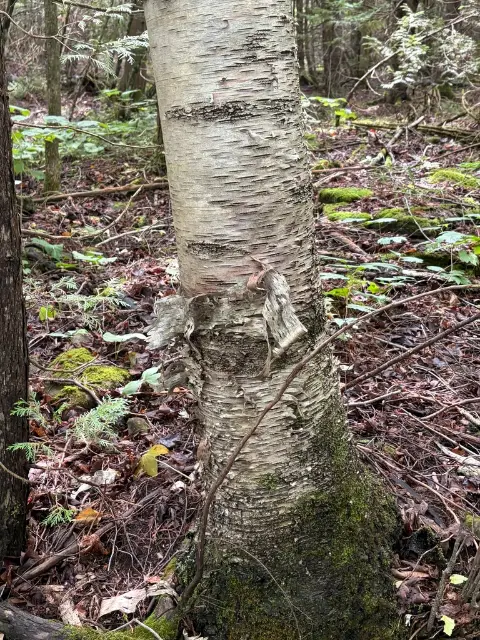
Paper birch

Photo: Amy MacPherson, CC BY-SA 4.0, via iNaturalist · Munster-Ashton, Ottawa, ON, CA, 2026-08-20

Trees · Native to Quebec

Paper birch

Betula papyrifera Betulaceae

Paper birch is a fast-growing deciduous tree with chalk-white bark that peels in thin papery strips to show orange-brown bark beneath. It is loosely pyramidal when young and opens into an irregular rounded crown with age, often on several trunks. Drooping male catkins and small upright female catkins appear in early spring as the leaves unfold. In fall the leaves turn a clear golden yellow, and in winter the white trunks stand out against snow and evergreens.

Latin
Betula papyrifera
Marshall · family Betulaceae · also Betula alba var. papyrifera (Marshall) Spach; Betula papyracea Aiton
English
Paper birch
Canoe birch, white birch
French
Bouleau à papier
Bouleau à canot, bouleau blanc
Kanien'kéha (Mohawk)
watenakè:taron's
watenakè:taronhs
Both spellings are given by the Greenbelt Indigenous Botanical Survey, which describes paper birch as the canoe birch whose bark served canoe building, baskets, home coverings, scrolls and birch-bark biting art.
Anishinaabemowin (Ojibwe)
wiigwaas
wiigwaasaatig, wiigwaasi-mitig
The Ojibwe People's Dictionary glosses wiigwaas (animate noun) as 'a birch' and wiigwaasaatig as 'a birch tree'. The Greenbelt survey spells it wiigwas, and Huron Smith (1932) recorded it as wîgwas.

Through the year

Paper birch in every season.

Story

The history of paper birch.

Paper birch grows across the boreal and northern hardwood forests from Newfoundland and Labrador to Alaska, south to New Jersey and the Virginia mountains. It is a pioneer tree that seeds into burns, clearings and moist hillsides and stream banks, and it prefers cool, moist soils. Its leaves feed the caterpillars of the eastern tiger swallowtail and the luna moth, and birds and mammals use its seeds, buds and cavities.

The Latin name Betula is the classical word for birch, and papyrifera means paper-bearing, after the bark. Humphry Marshall published the species name, and older works treated it as a variety of the European Betula alba. Indigenous peoples across its range built birchbark canoes and made baskets, containers, house coverings and scrolls from the bark, and rolled bark was used as a taper or a smudge stick against mosquitoes.

Sources: Lady Bird Johnson Wildflower Center: Betula papyrifera · NC State Extension Plant Toolbox: Betula papyrifera · VASCAN: Betula papyrifera · Greenbelt Indigenous Botanical Survey: Paper Birch

Characteristics

The plant at a glance.

Height15 to 21 m at maturity, often less in gardens
Spread7 to 14 m
HabitSingle or multi-trunked; pyramidal when young, irregular rounded crown with age
Bloom timeApril to May, as leaves emerge
FlowersSeparate male and female catkins on the same tree; male catkins drooping, up to 10 cm
FoliageSimple, alternate, toothed leaves; golden yellow in fall
FruitSmall winged nutlets (samaras) shed from cylindrical catkins in late summer and fall
HardinessZone 2
LightFull sun to part shade
MoistureMoist, cool, well-drained soil; dislikes heat and drought
Spread behaviourSelf-sows readily on bare or disturbed soil
Native rangeNewfoundland and Labrador to Alaska, south to New Jersey, the Virginia mountains and Oregon
Quebec statusNative

In the Flight Path Garden

Where it grows here.

ZonesMini-Forest
How many2
Planted2026

In the Mini-Forest the paper birch acts as a quick-growing pioneer canopy tree that shades out weeds while slower hardwoods establish. Its white bark adds winter structure and its leaves host native caterpillars that feed nesting birds.

Wildlife

Who uses it.

  • Larval host for the eastern tiger swallowtail and the luna moth.
  • Songbirds, ground-feeding birds and mammals use the tree for food and cover.
  • Aphids and leafminers on the foliage are part of the insect supply that birds glean in summer, so light damage is best tolerated rather than sprayed.

Sources: Lady Bird Johnson Wildflower Center: Betula papyrifera · NC State Extension Plant Toolbox: Betula papyrifera

Care

What to do, season by season.

Spring

Mulch the root zone with wood chips to keep the soil cool and moist. Prune only after the leaves are fully out, since birches bleed sap heavily when pruned in late winter.

Summer

Water deeply during dry spells in the first three years, because drought-stressed birches are more vulnerable to bronze birch borer.

Fall

Leave fallen leaves under the tree as mulch and let seedlings that appear in the mini-forest gaps grow if there is room.

Winter

No care needed. Check for broken limbs after ice storms and remove them cleanly once the leaves are out.

Relations

Knowledge and use.

The Greenbelt Indigenous Botanical Survey describes paper birch as the canoe birch, whose bark supplied canoe building, vessel making, basket weaving, home coverings, scrolls, birch-bark biting art and moose calls. Huron Smith recorded in 1932 that the Ojibwe used birch root as a seasoner in medicines. Birchbark canoes, baskets, cradles and snowshoe frames are documented across the tree's range.

Source: Greenbelt Indigenous Botanical Survey: Paper Birch · Huron H. Smith, Ethnobotany of the Ojibwe Indians (1932) · Lady Bird Johnson Wildflower Center: Betula papyrifera