Dorval and the West Island · Tiohtià:ke
Eco de l’OuestLow-mow lawns and eco gardens Book a consult
← All plants
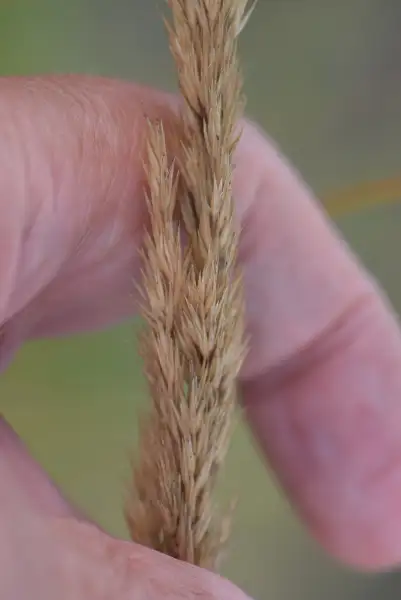
Feather reed grass

Photo: bobwardell (no rights reserved), CC0, via iNaturalist · Tipner, Portsmouth PO2, UK, 2024-08-14

Grasses, sedges and ferns · Introduced from Eurasia

Feather reed grass

Calamagrostis × acutiflora Poaceae

Feather reed grass forms a dense, upright clump of narrow, glossy green leaves to about 1 m. In early summer, feathery flower spikes rise well above the foliage, opening green and turning pink, bronze and finally tan. The seedheads stand through winter. 'Karl Foerster' is sterile, so it does not self-seed.

Latin
Calamagrostis × acutiflora
(Schrad.) DC. · family Poaceae
English
Feather reed grass
Foerster's feather reed grass
French
Calamagrostide
calamagrostide 'Karl Foerster'
Kanien'kéha (Mohawk)
Name not yet recorded
This is a European hybrid grass. No Kanien'kéha name exists in the Greenbelt survey, and none was found elsewhere.
Anishinaabemowin (Ojibwe)
Name not yet recorded
This is a European hybrid grass. Ojibwe People's Dictionary and the Greenbelt survey were not found to list it, and no name was invented.

Through the year

Feather reed grass in every season.

Story

The history of feather reed grass.

Calamagrostis × acutiflora is a naturally occurring hybrid between two Eurasian grasses, Calamagrostis arundinacea and Calamagrostis epigejos. It was named by Lamarck and de Candolle in 1815. Wild forms are occasional in Europe and Asia.

The cultivar 'Karl Foerster' is the form most often planted. Foerster, a German nurseryman, discovered it in the Hamburg Botanical Garden in the 1930s and brought it into commerce in 1950. It earned the Royal Horticultural Society's Award of Garden Merit and the 2001 Perennial Plant of the Year title.

Sources: Wikipedia: Calamagrostis × acutiflora · NC State Extension: Calamagrostis x acutiflora 'Karl Foerster'

'Karl Foerster'

An upright, sterile clump-former with stiff flower stalks that rise above the foliage. German nurseryman Karl Foerster found it at the Hamburg Botanical Garden in the 1930s and introduced it commercially in 1950; it was the Perennial Plant Association's Perennial Plant of the Year in 2001.

Where it comes from

How it got to Canada.

Native rangeEurope and Asia (a hybrid of two Eurasian species)

The cultivar 'Karl Foerster' was found in Hamburg in the 1930s and sold from 1950, after which it spread through ornamental gardening in Europe and North America. It was planted as a vertical accent grass. Because it is sterile and does not self-seed, it stays where it is planted; no Quebec invasive listing was checked or found in the sources reviewed.

Sources: NC State Extension: Calamagrostis x acutiflora 'Karl Foerster' · Wikipedia: Calamagrostis × acutiflora

Characteristics

The plant at a glance.

Height1 to 1.5 m in flower
Spread45 to 75 cm
HabitDense, erect clump
Bloom timeJune to July, with seedheads standing through winter
FlowersFeathery plumes, green then pink, bronze and tan
FoliageNarrow, glossy, bright green leaves
FruitSterile; no viable seed
HardinessZone 5
LightFull sun to part shade
MoistureMedium to wet; tolerates clay
Spread behaviourClumping; does not self-seed
Native rangeHybrid of Eurasian species
Quebec statusNot native, cultivated

In the Flight Path Garden

Where it grows here.

ZonesOrnamental Border, Full Sun · Ornamental Border, Partial Sun
How many9
Planted2025 and 2026

In the front borders it adds a tall, narrow vertical line that holds its shape through winter. Its sterility keeps it from seeding into the native plantings.

Wildlife

Who uses it.

  • Offers little as a food plant, though the dense clumps and standing seedheads give insects and small birds winter shelter.
  • Highly resistant to deer and rabbit browsing.
  • Sterile, so it provides no seed crop and does not spread into wild areas.

Sources: NC State Extension: Calamagrostis x acutiflora 'Karl Foerster'

Care

What to do, season by season.

Spring

Cut the whole clump to about 10 cm in March or early April before new growth starts. Divide crowded clumps if the centre thins.

Summer

Water during long dry spells, though it tolerates wet soil and clay.

Fall

Leave the golden-tan stalks standing for structure.

Winter

Plants are hardy. The upright seedheads hold up well under light snow.

Relations

Knowledge and use.

Nothing recorded yet from a source we can cite.