Dorval and the West Island · Tiohtià:ke
Eco de l’OuestLow-mow lawns and eco gardens Book a consult
← All plants
Bluejoint

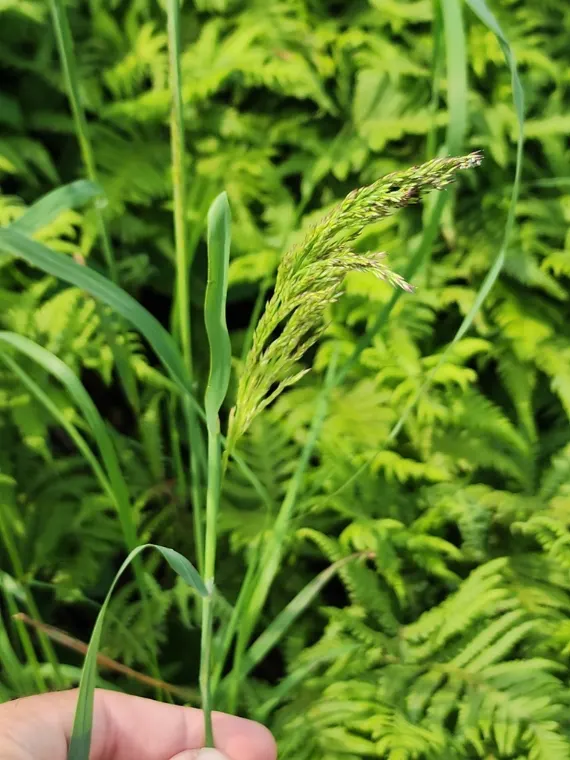
Photo: Étienne Léveillé-Bourret, CC BY 4.0, via iNaturalist · Gaspésie–Îles-de-la-Madeleine, QC, Canada, 2025-07-13

Grasses, sedges and ferns · Native to Quebec

Bluejoint

Calamagrostis canadensis Poaceae

Bluejoint is a tall, cool-season native grass with slender, unbranched stems and narrow, soft, blue-green to medium green leaves that arch and droop. In early to mid summer each fertile stem carries an open, airy panicle of tiny pale green to purplish spikelets, which closes up and turns straw-coloured as the seed ripens in late summer. It spreads by creeping rhizomes and can form a loose sod or a broad colony in moist ground. The tan stems and seed heads stand into winter. It differs from the feather reed grass 'Karl Foerster' elsewhere in the garden, a non-native hybrid that stays in a tight, upright clump; bluejoint has softer, looser foliage and travels by its roots.

Latin
Calamagrostis canadensis
(Michx.) P. Beauv. · family Poaceae · also Arundo canadensis Michx.
English
Bluejoint
bluejoint reedgrass, Canada bluejoint, Canada reedgrass, marsh reedgrass
French
Calamagrostide du Canada
calamagrostis du Canada, foin bleu
Kanien'kéha (Mohawk)
Name not yet recorded
No Kanien'kéha name was found. The Greenbelt Indigenous Botanical Survey pages checked for bluejoint did not return a species page, and a web search found no other citable source.
Anishinaabemowin (Ojibwe)
Name not yet recorded
The Ojibwe People's Dictionary search for 'bluejoint' returned no results, and no other citable Anishinaabemowin name was found.

Through the year

Bluejoint in every season.

Story

The history of bluejoint.

Bluejoint is the most common and widespread Calamagrostis species in North America, growing from Greenland to Alaska and south to North Carolina, Kansas and California. It grows in wet meadows, marshes, sedge meadows, fens, bogs, swamps and the edges of moist woods, and in some of these habitats it is the dominant ground cover. In Quebec it is native and occurs from the St. Lawrence Valley, the Eastern Townships, the Laurentians and the Outaouais to the centre and north of the province. Its tough rhizomes hold soil in wet places, and it is one of the first plants to return to burned, logged or oil-spill sites.

The French botanist André Michaux described the plant in 1803 as Arundo canadensis in his Flora Boreali-Americana, and Palisot de Beauvois moved it to the genus Calamagrostis in 1812. The name foin bleu, recorded by Marie-Victorin, reflects its long use as wild hay. Livestock and wild grazers eat it, and it makes good hay when cut before the seed heads form. In Alaska and in white spruce plantations it is treated as a weed because it forms dense stands that crowd out tree seedlings.

Sources: Wikipedia: Calamagrostis canadensis · Espace pour la vie, Biodôme flora: Bluejoint · VASCAN: Calamagrostis canadensis · USDA NRCS Plant Guide: Bluejoint · Illinois Wildflowers: Bluejoint Grass

'Sourdough'

A selection developed in Alaska for cold and wind tolerance, used mainly for revegetation and forage seedings.

Characteristics

The plant at a glance.

Height60 to 150 cm
Spread60 cm or more; forms colonies over time
HabitUpright, loose, sod-forming grass with arching leaves
Bloom timeLate June to July
FlowersOpen, airy panicles of tiny pale green to purplish spikelets; wind-pollinated
FoliageNarrow, flat, drooping blue-green to medium green leaves
FruitTiny light brown grains with soft hairs, carried by wind and water
HardinessZone 2
LightFull sun to part shade
MoistureMoist to wet
Spread behaviourRhizomes; spreads steadily and can be aggressive in rich, wet soil
Native rangeGreenland to Alaska, south to North Carolina, Kansas and California
Quebec statusNative

In the Flight Path Garden

Where it grows here.

ZonesOrnamental Border, Full Sun · Ornamental Border, Partial Sun · St. Lawrence Lowlands Demonstration Garden · Meadow and Alternative Lawn Bed · Mini-Forest · Rain Garden #1 · Rain Garden #2 · Hügelkultur Garden · Back Ornamental Border · St. Lawrence Lowlands Eco Mix Lawn
How many45
Planted2026

Planted in every bed of the garden, its rhizomes knit the soil together and hold it on slopes and mounds. It does its strongest work in wetter spots such as the rain gardens, where it tolerates soggy soil and short periods of standing water.

Wildlife

Who uses it.

  • Dense stands give nesting habitat for wetland birds and cover for small mammals, snakes and other wildlife.
  • Leaves and stems feed plant bugs, aphids, leafhoppers and the delicate meadow katydid, and waterfowl eat its seeds.
  • Deer graze it, and muskrats eat its roots and lower stems; established colonies recover well from browsing.

Sources: Illinois Wildflowers: Bluejoint Grass · USDA NRCS Plant Guide: Bluejoint

Care

What to do, season by season.

Spring

Cut last year's stems to about 10 cm in early spring before new shoots appear. Dig out runners where it moves into paths or into smaller neighbours.

Summer

Water new plantings through their first summer; once established it needs watering only in long dry spells outside the wet beds. It flowers in early summer and needs no deadheading.

Fall

Leave the stems and seed heads standing for birds and winter cover.

Winter

Let snow press the stems down; they protect the crowns and soil. Cut back in early spring.

Relations

Knowledge and use.

Nothing recorded yet from a source we can cite.