Dorval and the West Island · Tiohtià:ke
Eco de l’OuestLow-mow lawns and eco gardens Book a consult
← All plants
Flat-topped white aster

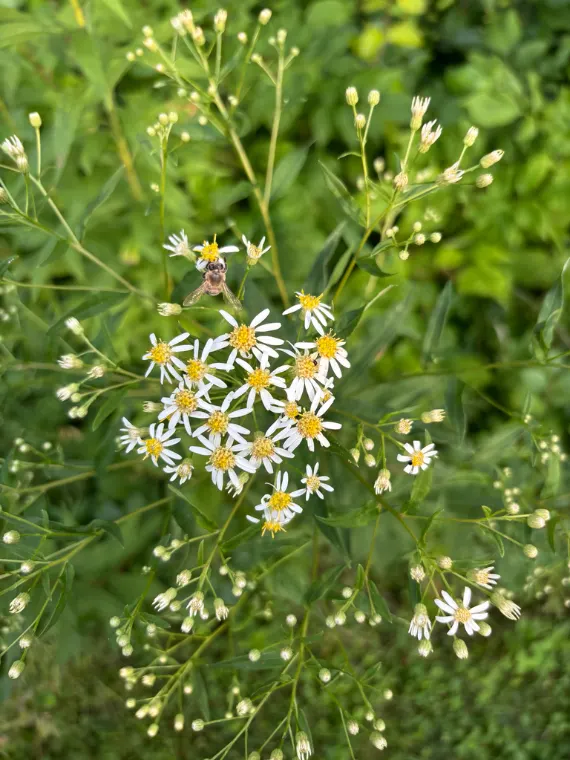
Photo: Alex Day, CC BY 4.0, via iNaturalist · Gatineau, CA-QC-OU, CA-QC, CA, 2026-08-07

Flowers and groundcovers · Native to Quebec

Flat-topped white aster

Doellingeria umbellata Asteraceae

Flat-topped white aster is a tall perennial with stiff, upright stems lined with narrow, pointed leaves and no basal rosette. In August and September each stem ends in a broad, flat cluster of small white daisies with yellow centres that fade to cream. It spreads slowly by rhizomes into small colonies in moist ground. Fluffy seed heads follow the flowers, and the stems stand through winter.

Latin
Doellingeria umbellata
(Mill.) Nees · family Asteraceae · also Aster umbellatus Mill.; Aster amygdalinus Lam.; Diplopappus umbellatus (Mill.) Hook.; Doellingeria pubens (A.Gray) Rydb.
English
Flat-topped white aster
parasol whitetop, tall flat-topped white aster, flat-topped aster
French
Aster à ombelles
Kanien'kéha (Mohawk)
Name not yet recorded
No Kanien'kéha name was found. The Greenbelt Indigenous Botanical Survey pages checked for flat-topped aster could not be reached, and a search of the site returned no aster page.
Anishinaabemowin (Ojibwe)
Name not yet recorded
The Ojibwe People's Dictionary search for 'aster' returned no results, and no other citable Anishinaabemowin name was found.

Through the year

Flat-topped white aster in every season.

Story

The history of flat-topped white aster.

Flat-topped white aster grows in moist thickets, wet meadows, fens, seeps, swamp edges and wooded openings from Alberta to Newfoundland and south to Georgia and Alabama. It is one of the first asters to bloom each year and is the main host plant of Harris's checkerspot butterfly. In Quebec it is native.

The English botanist Philip Miller first described it as Aster umbellatus, and the German botanist Nees von Esenbeck later moved it to the genus Doellingeria, named for the German physician Ignaz Döllinger (1770–1841). The species name umbellata refers to the umbrella-like flower clusters. Botanists in the late 1800s and early 1900s kept Doellingeria separate, many later folded it back into Aster, and DNA studies now support it again as its own North American genus.

Sources: Illinois Wildflowers: Flat-topped aster · Lady Bird Johnson Wildflower Center: Doellingeria umbellata · Wikipedia: Doellingeria umbellata · Putnam Park Wildflowers (University of Wisconsin–Eau Claire): Doellingeria umbellata · University of Waterloo Astereae Lab: Doellingeria · VASCAN: Doellingeria umbellata

Characteristics

The plant at a glance.

Height60 to 200 cm
Spread90 to 120 cm
HabitUpright perennial on stiff, mostly unbranched stems
Bloom timeAugust to September
FlowersSmall white heads with 5 to 12 rays and yellow centres, in flat-topped clusters 8 to 30 cm across
FoliageAlternate, narrow, pointed leaves 8 to 13 cm long; no basal leaves
FruitSmall achenes with fluffy bristles, spread by wind
HardinessZone 3
LightFull sun to part shade
MoistureMoist to wet
Spread behaviourRhizomes; forms small colonies
Native rangeAlberta to Newfoundland, south to Georgia and Alabama
Quebec statusNative

In the Flight Path Garden

Where it grows here.

ZonesOrnamental Border, Full Sun · Ornamental Border, Partial Sun · St. Lawrence Lowlands Demonstration Garden · Meadow and Alternative Lawn Bed · Mini-Forest · Rain Garden #1 · Rain Garden #2 · Hügelkultur Garden · Back Ornamental Border · St. Lawrence Lowlands Eco Mix Lawn
How many45
Planted2026

Planted in every bed of the garden, it adds flat clusters of white flowers in August and September, when bees need late food. It does best in the moist low spots of the rain gardens and the meadow bed, where its rhizomes slowly form small colonies.

Wildlife

Who uses it.

  • Main caterpillar host plant of Harris's checkerspot (Chlosyne harrisii); crescent butterfly caterpillars also feed on it.
  • Flowers draw bumble bees, many solitary bees including aster specialists such as Andrena nubecula and Andrena placata, wasps, syrphid flies and skippers.
  • American tree sparrows eat the seeds and ruffed grouse eat leaves and seeds; white-tailed deer browse it, so protect young plants where deer are common.

Sources: Illinois Wildflowers: Flat-topped aster · Native Plant Trust Plant Finder: Doellingeria umbellata

Care

What to do, season by season.

Spring

Cut last year's stems to the ground as new shoots appear. Divide crowded clumps in early spring if needed.

Summer

Water young plants in dry spells during their first summer. Tall stems can lean in rich soil, so let neighbouring plants hold them up.

Fall

Leave the seed heads standing for birds and winter interest.

Winter

Leave stems standing as shelter for overwintering insects and cut them back in early spring.

Relations

Knowledge and use.

Nothing recorded yet from a source we can cite.