Dorval and the West Island · Tiohtià:ke
Eco de l’OuestLow-mow lawns and eco gardens Book a consult
← All plants
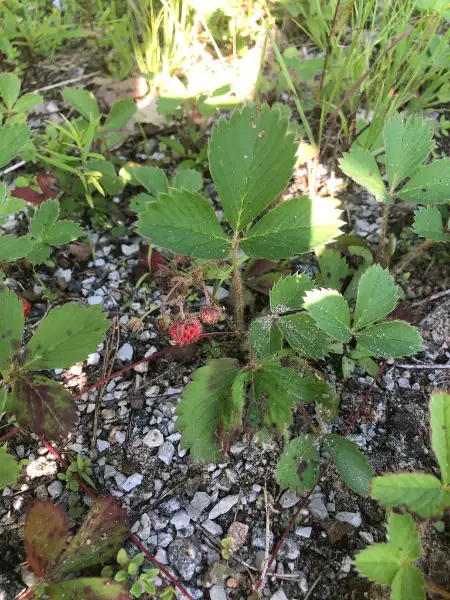
Virginia strawberry

Photo: Abby Ciona, CC BY 4.0, via iNaturalist · Widjiitiwin Rd, Huntsville, ON, CA, 2023-06-29

Flowers and groundcovers · Native to Quebec

Virginia strawberry

Fragaria virginiana Rosaceae

Virginia strawberry is a low perennial about 10 cm tall with bluish-green trifoliate, toothed leaves that turn red-bronze in fall. White five-petalled flowers appear in late spring and give way to small, sweet red berries in early summer. Runners root along the ground and form a spreading patch. It tolerates light foot traffic and mowing at a high setting.

Latin
Fragaria virginiana
Mill. · family Rosaceae · also Fragaria virginiana Duchesne (invalid name)
English
Virginia strawberry
wild strawberry
French
Fraisier de Virginie
Kanien'kéha (Mohawk)
ken'niiohontesha
niyohentéhsha', niyohontéhsa, ken'niyohontésha
Four spellings given for Wild Strawberry on the Greenbelt Indigenous Botanical Survey page, which does not say which community uses each.
Anishinaabemowin (Ojibwe)
odeimin
ode'imin
Greenbelt survey writes 'odeimin (-an, plural)'. Ojibwe People's Dictionary lists ode'imin as an inanimate noun meaning 'a strawberry'.

Through the year

Virginia strawberry in every season.

Story

The history of virginia strawberry.

Virginia strawberry is native to all Canadian provinces and to every US state. It grows in moderate to cool climates in sun or part shade, favouring well-drained sandy loam. Bees, flies and ants visit the flowers, and bears, mice, raccoons and others eat the fruit and spread the seed. It spreads by seed and by runners that form clumped patches.

It was one of the parents of the modern garden strawberry. The cultivated strawberry (Fragaria x ananassa) came from a cross of Fragaria virginiana, brought from Virginia to Europe, with Chilean strawberry. Its botanical authority is disputed between Philip Miller (1768) and Antoine Duchesne (1766). Haudenosaunee tradition calls it the leader of the berries because it ripens first.

Sources: Wikipedia: Fragaria virginiana · VASCAN: Fragaria virginiana · Greenbelt Indigenous Botanical Survey: Wild, Woodland and Mock Strawberry

Characteristics

The plant at a glance.

HeightUp to 10 cm
Spread30 to 60 cm and more by runners
HabitLow mat-forming perennial
Bloom timeMay to June
FlowersWhite, five petals, yellow centre
FoliageTrifoliate toothed leaves about 10 cm long
FruitSmall red berries, smaller than garden strawberries
HardinessZone 3
LightFull sun to part shade
MoistureMedium, well-drained
Spread behaviourRunners (stolons) and seed
Native rangeAll Canadian provinces and territories and all US states
Quebec statusNative

In the Flight Path Garden

Where it grows here.

ZonesMeadow and Alternative Lawn Bed · St. Lawrence Lowlands Eco Mix Lawn
How many27
Planted2023

In the Meadow and Alternative Lawn bed and the Eco Mix Lawn it forms a low native mat between grasses, offering early flowers for small bees and fruit for wildlife.

Wildlife

Who uses it.

  • Flowers are visited by bees, flies and ants for pollen and nectar.
  • Fruit is eaten by bears, mice, raccoons and other mammals and birds, which spread the seed.
  • The leaves attract parasitoid wasps that prey on aphids and leafhoppers.

Sources: Wikipedia: Fragaria virginiana

Care

What to do, season by season.

Spring

Rake off winter debris and let runners root. Thin patches that spread into beds.

Summer

Pick berries as they ripen, or leave them for birds. Water in drought while establishing.

Fall

Leaves redden; leave them in place. Move rooted runners to fill gaps.

Winter

Leaves stay semi-evergreen under snow; no protection is needed.

Relations

Knowledge and use.

The Greenbelt Indigenous Botanical Survey records that the Haudenosaunee call strawberry the leader of the berries because it ripens first, and quotes the teaching that strawberries are women's medicine and that processing them is traditionally women's work. F. W. Waugh documented ceremonial use in the early 1900s, and Alyssa General told a story of strawberries as a way to settle anger between couples.

Source: Greenbelt Indigenous Botanical Survey: Wild, Woodland and Mock Strawberry