Dorval and the West Island · Tiohtià:ke
Eco de l’OuestLow-mow lawns and eco gardens Book a consult
← All plants
Soft rush

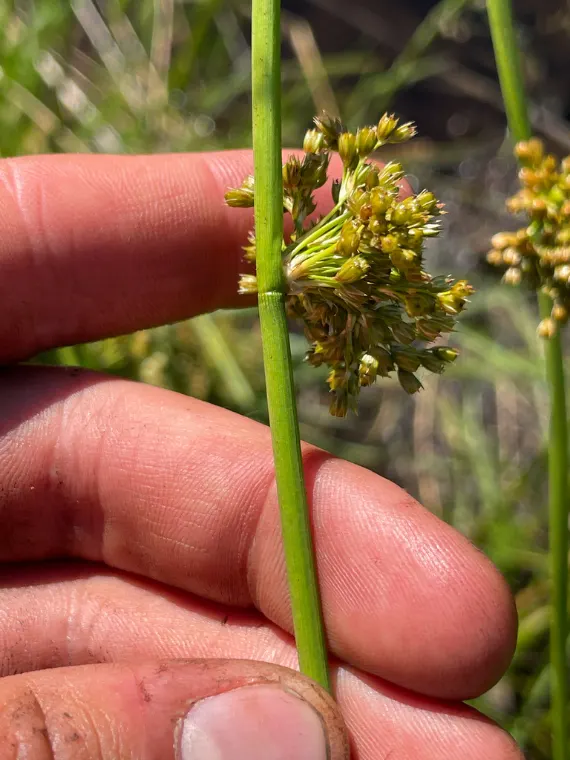
Photo: Sam Turner, CC BY 4.0, via iNaturalist · Wawa, ON, CA, 2025-08-14

Grasses, sedges and ferns · Native to Quebec

Soft rush

Juncus effusus Juncaceae

Soft rush grows in dense, upright clumps of smooth, round, deep green stems that have no true leaf blades. In early summer small greenish-brown flowers appear in a loose cluster that seems to burst from the side of each stem near the top. The flowers turn into small brown capsules full of tiny seeds by late summer. The stems stay green well into fall and stand through winter, turning tan before new shoots push up in spring.

Latin
Juncus effusus
L. · family Juncaceae · also Eastern North American plants: Juncus effusus var. solutus Fernald & Wiegand; Juncus griscomii Fernald
English
Soft rush
common rush, bog rush, lamp rush
French
Jonc épars
jonc diffus; jonc lâche (sous-espèce indigène solutus)
Kanien'kéha (Mohawk)
Name not yet recorded
No Kanien'kéha name was found. The Greenbelt Indigenous Botanical Survey has no soft rush page at the address checked, and a site search found none.
Anishinaabemowin (Ojibwe)
Name not yet recorded
No species-specific Anishinaabemowin name was found. The Ojibwe People's Dictionary gives anaakanashk (plural anaakanashkoon) as a general word for 'a reed, a rush', without naming a species, so it is not shown as this plant's name.

Through the year

Soft rush in every season.

Story

The history of soft rush.

Soft rush grows in marshes, wet meadows, ditches, pond edges, swamps and damp open ground across much of North America and on every continent except Australia and Antarctica. Muskrats feed on its rootstalks, and the clumps give cover to wetland birds and small mammals. It is also studied for constructed wetlands because it takes up nutrients from wastewater. In Quebec the species is native, mainly as the eastern subspecies solutus, called jonc lâche. The Eurasian subspecies effusus is introduced here, and the similar Pylaie's rush (Juncus pylaei) is treated as a separate native species.

The genus name comes from iuncus, the Latin word for rush, and effusus means spread out, a reference to the loose flower cluster. In Europe the peeled pith was soaked in fat to make rushlights, a cheap replacement for candles, which explains the old name lamp rush. In Japan the same species, called igusa, is woven into the covers of tatami mats.

Sources: Wikipedia: Juncus effusus · Lady Bird Johnson Wildflower Center: Juncus effusus · VASCAN: Juncus effusus subsp. solutus · VASCAN: Juncus effusus subsp. effusus · Wiktionary: Juncus

'Spiralis'

Corkscrew rush has stems that twist into tight curls and grows to about 45 cm tall and wide, so it is used as a specimen or container plant. Garden stock of it is European in origin, and no record of who first selected it was found.

Characteristics

The plant at a glance.

Height30 to 120 cm
Spread30 to 60 cm
HabitDense, upright clump of round stems
Bloom timeJune to July
FlowersTiny, greenish-brown, in a loose cluster on the side of the stem near the tip
FoliageNo true leaf blades; smooth, round, deep green stems with brown basal sheaths
FruitSmall brown capsules with many tiny seeds
HardinessZone 4
LightFull sun to part shade
MoistureMoist to wet; tolerates shallow standing water
Spread behaviourClumping; widens slowly and self-sows in wet, bare soil
Native rangeMost of North America except the far north; also Europe, Asia, Africa and South America
Quebec statusNative (subsp. solutus); Eurasian subsp. effusus introduced

In the Flight Path Garden

Where it grows here.

ZonesOrnamental Border, Full Sun · Ornamental Border, Partial Sun · St. Lawrence Lowlands Demonstration Garden · Meadow and Alternative Lawn Bed · Mini-Forest · Rain Garden #1 · Rain Garden #2 · Hügelkultur Garden · Back Ornamental Border · St. Lawrence Lowlands Eco Mix Lawn
How many45
Planted2026

Planted in every bed of the garden, it fills the wettest low spots with green stems most of the year. In both rain gardens it takes standing water after storms and holds the soil of the basins in place.

Wildlife

Who uses it.

  • Muskrats eat the rootstalks.
  • Birds use the dense stems for shelter, and wetland birds feed and nest among the clumps.
  • Deer resistance is moderate; deer and livestock seldom graze it.

Sources: Lady Bird Johnson Wildflower Center: Juncus effusus · Wikipedia: Juncus effusus

Care

What to do, season by season.

Spring

Cut or comb out the old tan stems once new green shoots appear. Divide crowded clumps in spring if needed.

Summer

Keep the soil moist; plants in drier beds turn yellow in long dry spells. Cut off seed heads after flowering where you want to limit self-sowing.

Fall

Leave the clumps standing; the stems stay green late into the season.

Winter

Leave stems in place for cover and snow catch, and tidy them in spring.

Relations

Knowledge and use.

In Europe the peeled pith of soft rush was soaked in grease and burned as a rushlight, a cheap alternative to candles. In Japan the species, called igusa, is woven into the covering of tatami mats. No citable Indigenous knowledge specific to this species was found.

Source: Wikipedia: Juncus effusus