Dorval and the West Island · Tiohtià:ke
Eco de l’OuestLow-mow lawns and eco gardens Book a consult
← All plants
Bird's-foot trefoil

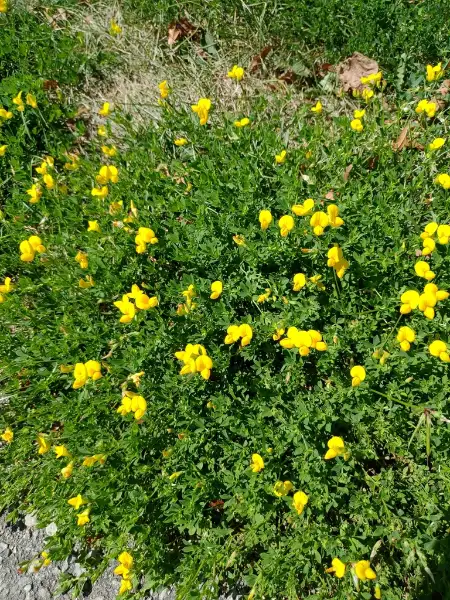
Photo: shawnchong (no rights reserved), CC0, via iNaturalist · Richmond Hill, ON L4B 4L4, Canada, 2022-08-10

Flowers and groundcovers · Introduced from Eurasia and North Africa

Bird's-foot trefoil

Lotus corniculatus Fabaceae

Bird's-foot trefoil is a low, sprawling legume with clover-like leaves of five leaflets and clusters of golden-yellow pea flowers from June to September. Stems lie along the ground or rise partly upright, usually 5 to 20 cm tall and sometimes taller when supported by other plants. It tolerates mowing and trampling, which makes it a common part of lawn and meadow mixes. The seedpods spread like the toes of a bird's foot.

Latin
Lotus corniculatus
L. · family Fabaceae · also Lotus corniculatus var. arvensis (Pers.) Ser.
English
Bird's-foot trefoil
garden bird's-foot trefoil, horned trefoil
French
Lotier corniculé
Kanien'kéha (Mohawk)
Name not yet recorded
Introduced European plant, not in the Greenbelt Indigenous Botanical Survey. No Kanien'kéha name was found.
Anishinaabemowin (Ojibwe)
Name not yet recorded
Introduced European plant, not in the Greenbelt Indigenous Botanical Survey. No Anishinaabemowin name was found.

Through the year

Bird's-foot trefoil in every season.

Story

The history of bird's-foot trefoil.

Bird's-foot trefoil is native to temperate Eurasia and North Africa, where it grows in grassland and on sandy soils and tolerates grazing. Bumblebees are its main visitors, along with honey bees and mason bees, and several European butterflies use it as a caterpillar food plant.

It was brought to North America for livestock forage and erosion control and planted in pastures and along roadsides. It now escapes into natural areas and is considered invasive in many parts of North America, where it forms dense mats that shade out native plants. The common name refers to the pod shape and the three prominent leaflets.

Sources: Wikipedia: Lotus corniculatus · Minnesota DNR: Birdsfoot trefoil

Where it comes from

How it got to Canada.

Native rangeTemperate Eurasia and North Africa

It was introduced to the United States and Canada on purpose as livestock forage and for erosion control, and it spread from planted pastures and roadsides into natural areas. VASCAN documents it across most Canadian provinces, including Quebec, and the species is regarded as invasive in many parts of North America; the Quebec-specific status and any provincial watch list were not confirmed in the sources checked. In the Flight Path Garden it grows as part of a bee-lawn seed mix and should be kept away from natural areas.

Sources: Minnesota DNR: Birdsfoot trefoil · Wikipedia: Lotus corniculatus · VASCAN: Lotus corniculatus

Characteristics

The plant at a glance.

Height5 to 20 cm; stems to 50 cm when supported
SpreadMat-forming, spreading by trailing stems and seed
HabitLow, sprawling, partly upright
Bloom timeJune to September
FlowersYellow pea-shaped flowers about 1.3 cm long in flat-topped clusters
FoliageFive clover-like leaflets, the central three held above the outer pair
FruitSlender pods, up to 25 seeds, spreading like a bird's foot
HardinessHardy in Montréal's zone 5a
LightFull sun to light shade
MoistureDry to moist; often on sandy soil
Spread behaviourSpreads by seed carried by animals, water and mowers, and forms dense mats
Native rangeTemperate Eurasia and North Africa
Quebec statusIntroduced, naturalized

In the Flight Path Garden

Where it grows here.

ZonesMeadow and Alternative Lawn Bed · St. Lawrence Lowlands Eco Mix Lawn
How manySown from seed mix
Planted2023 and 2024

It adds low yellow flowers for bumblebees and other bees to the Meadow and Alternative Lawn bed and the Eco Mix Lawn, and it tolerates mowing and foot traffic.

Wildlife

Who uses it.

  • Mostly visited by bumblebees, and also by honey bees and mason bees.
  • A larval food plant for several European butterflies, including the six-spot burnet moth and wood white.
  • Grazed as forage by livestock; deer resistance was not confirmed.

Sources: Wikipedia: Lotus corniculatus

Care

What to do, season by season.

Spring

Sow or overseed bare patches of the bee lawn in April or May. Watch for spread into beds or neighbouring wild areas.

Summer

Mow high and less often to let it flower for bees. Remove runners that reach flower beds.

Fall

Deadhead or mow before pods ripen if you want to limit seed spread.

Winter

No care needed; the mat dies back and resprouts in spring.

Relations

Knowledge and use.

Nothing recorded yet from a source we can cite.