Dorval and the West Island · Tiohtià:ke
Eco de l’OuestLow-mow lawns and eco gardens Book a consult
← All plants
Sensitive fern

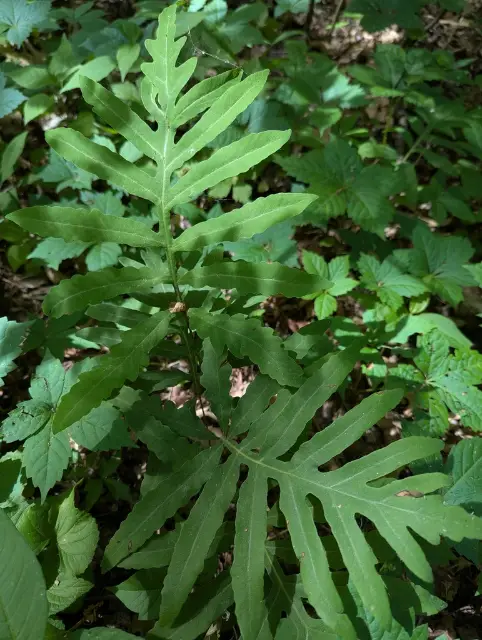
Photo: Brad McLeod, CC BY 4.0, via iNaturalist · Essex County, ON, Canada, 2026-06-06

Grasses, sedges and ferns · Native to Quebec

Sensitive fern

Onoclea sensibilis Onocleaceae

Sensitive fern is a deciduous fern with coarse, bright yellow-green, deeply lobed sterile fronds up to about 1 m tall. Separate, shorter fertile fronds carry the spores in tight bead-like clusters that turn dark brown and stand through winter. It spreads steadily by rhizomes into broad colonies in damp ground. The fronds collapse at the first autumn frost.

Latin
Onoclea sensibilis
L. · family Onocleaceae
English
Sensitive fern
bead fern, meadow brake, polypod brake
French
Onoclée sensible
onoclée
Kanien'kéha (Mohawk)
tsyohtehrí:seron
Name given for Sensitive Fern on the Greenbelt Indigenous Botanical Survey fern page.
Anishinaabemowin (Ojibwe)
a'nana'ganak
naanaaganashkoon
Names given for Sensitive Fern on the Greenbelt survey fern page. The Ojibwe People's Dictionary search for Onoclea returned no entries.

Through the year

Sensitive fern in every season.

Story

The history of sensitive fern.

Sensitive fern is native from Newfoundland to Florida and west to Texas, the Rockies and Manitoba, including Quebec. It grows in wet meadows, bogs and stream banks and tolerates very wet, acidic soil. Deer bed down in its mats and wild turkeys eat the spore stalks. Fossils of virtually identical fronds are about 57 million years old.

Linnaeus named the genus in 1751 and the species in Species Plantarum in 1753. Onoclea comes from Greek words for a vessel and to close, describing the tightly rolled fertile fronds, and sensibilis refers to the fern's sensitivity to the first frost and to drought. The Greenbelt survey notes that Katie Dybeau of Kahnawà:ke told F. W. Waugh about uses of the roots of several ferns, including this one.

Sources: Wikipedia: Onoclea sensibilis · VASCAN: Onoclea sensibilis · Greenbelt Indigenous Botanical Survey: Bracken, Christmas, Cinnamon, Lady, Maidenhair, Ostrich and Sensitive Fern

Characteristics

The plant at a glance.

Height60 to 130 cm sterile fronds
SpreadForms colonies; slowly wide
HabitDeciduous colony-forming fern
Bloom timeNo flowers; spores shed in fall
FrondsSterile fronds yellow-green, deeply lobed, 1 to 1.3 m; fertile fronds 20 to 45 cm
SporesBead-like fertile fronds turn brown and persist through winter
HardinessZone 4
LightPart shade to shade; tolerates sun in wet soil
MoistureMoist to wet; tolerates drier shade
Spread behaviourRhizomes and spores; can become aggressive
Native rangeNewfoundland to Florida, west to Texas, the Rockies and Manitoba
Quebec statusNative

In the Flight Path Garden

Where it grows here.

ZonesHügelkultur Garden
How many3
Planted2025

It covers damp, shaded ground with a bright, lush fern layer that fills in quickly and needs no care once established.

Wildlife

Who uses it.

  • Deer bed down in dense mats of the fern, and wild turkeys eat the fertile spore stalks.
  • Hosts aphids, fern miners, sawfly larvae and some moths.
  • The foliage contains defensive chemicals, so it is rarely browsed.

Sources: Wikipedia: Onoclea sensibilis

Care

What to do, season by season.

Spring

Fronds unfurl in late spring; divide or move clumps at this time if they have spread too far.

Summer

Keep soil moist in dry spells, since fronds scorch in drought.

Fall

Fronds die back at the first frost. Leave the brown fertile fronds standing for winter interest.

Winter

Leave dried frond bases in place, because they improve winter survival.

Relations

Knowledge and use.

The Greenbelt Indigenous Botanical Survey cites Katie Dybeau of Kahnawà:ke, recorded by F. W. Waugh, as describing medicinal uses of the roots of Cinnamon, Christmas, Maidenhair and Sensitive Ferns.

Source: Greenbelt Indigenous Botanical Survey: Bracken, Christmas, Cinnamon, Lady, Maidenhair, Ostrich and Sensitive Fern