Dorval and the West Island · Tiohtià:ke
Eco de l’OuestLow-mow lawns and eco gardens Book a consult
← All plants
Cut-leaved coneflower

Photo: Benoit Renaud, CC BY 4.0, via iNaturalist · Lefrançois / Des Vignobles, Rosemère, QC J7A, Canada, 2022-09-08

Flowers and groundcovers · Native to Quebec

Cut-leaved coneflower

Rudbeckia laciniata Asteraceae

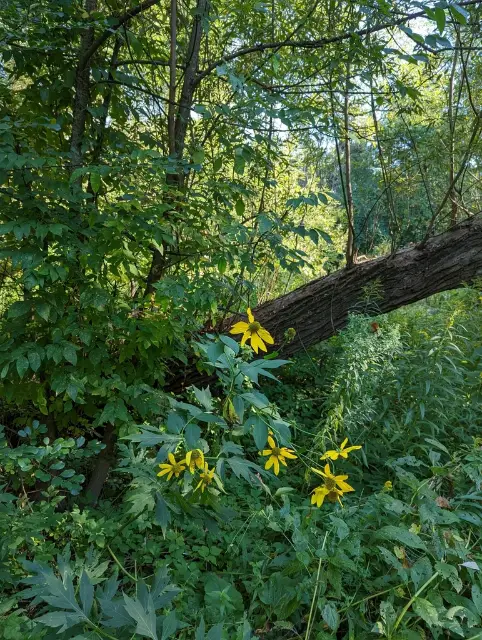
Cut-leaved coneflower is a tall perennial with deeply lobed, gray-green leaves that emerge early in spring. From midsummer into autumn it carries daisy-like flowers 7 to 10 cm across, with swept-back golden rays around a greenish-yellow cone. Plants reach about 1 to 2 m. It spreads by underground stems to form large patches.

Latin
Rudbeckia laciniata
L. · family Asteraceae
English
Cut-leaved coneflower
green-headed coneflower, tall coneflower
French
Rudbeckie laciniée
rudbeckie lacinié
Kanien'kéha (Mohawk)
Name not yet recorded
The Greenbelt Indigenous Botanical Survey species list (pages 1 to 10) has no coneflower entry. No other citable Kanien'kéha source was found.
Anishinaabemowin (Ojibwe)
Name not yet recorded
Not listed on the Greenbelt Indigenous Botanical Survey. No Ojibwe source for this species was identified.

Through the year

Cut-leaved coneflower in every season.

Story

The history of cut-leaved coneflower.

Cut-leaved coneflower grows from Quebec south to northern Florida and west to Idaho and Arizona, in low woodlands, wet fields, floodplains, stream banks and alluvial thickets. It forms long rhizomes that let it persist and spread, and it is especially valued by native bees and honey bees.

Wikipedia records that the plant reached Paris in the 1600s and was in garden cultivation from 1646. The double-flowered form 'Golden Glow' has been known since about 1894. The Lady Bird Johnson Wildflower Center notes that Cherokee and other southeastern peoples harvested the early spring leaves.

Sources: Wikipedia: Rudbeckia laciniata · Lady Bird Johnson Wildflower Center: Rudbeckia laciniata · VASCAN: Rudbeckia laciniata

Characteristics

The plant at a glance.

Height1 to 2 m, up to about 3 m in rich soil
SpreadForms patches by rhizomes
HabitTall, branched, leafy stems
Bloom timeJuly to October
Flowers7 to 10 cm daisies with 8 to 12 swept-back golden rays and a greenish-yellow cone
FoliageGray-green, deeply lobed to dissected leaves, early to emerge
FruitBrown seed cones that elongate as seeds mature
HardinessHardy in Montréal's zone 5a
LightSun, part shade or shade
MoistureMoist, slightly acid soil; low water needs once established
Spread behaviourSpreads vigorously by long underground rhizomes
Native rangeQuebec south to northern Florida, west to Idaho and Arizona
Quebec statusNative

In the Flight Path Garden

Where it grows here.

ZonesBack Ornamental Border · St. Lawrence Lowlands Demonstration Garden
How many90
Planted2026

Planted in large numbers, it makes a tall, late-season mass of yellow for bees and holds moist ground with its spreading rhizomes.

Wildlife

Who uses it.

  • Special value to native bees and honey bees in late summer.
  • Birds feed on the seed heads in fall.
  • Deer resistance was not confirmed in the sources checked.

Sources: Lady Bird Johnson Wildflower Center: Rudbeckia laciniata

Care

What to do, season by season.

Spring

Early leaves emerge in April. Thin or pull patches that spread beyond their intended area while shoots are young.

Summer

Stake tall stems in windy spots, or cut them back by half in early June to keep plants shorter. Water in long dry spells.

Fall

Leave the seed heads for goldfinches and other birds.

Winter

No protection needed. Cut stems back in late winter and divide crowded patches in spring.

Relations

Knowledge and use.

The Lady Bird Johnson Wildflower Center records that the early spring leaves were harvested by Cherokee and other southeastern peoples. No Kanien'kéha or Anishinaabemowin source for this species was found.

Source: Lady Bird Johnson Wildflower Center: Rudbeckia laciniata