Dorval and the West Island · Tiohtià:ke
Eco de l’OuestLow-mow lawns and eco gardens Book a consult
← All plants
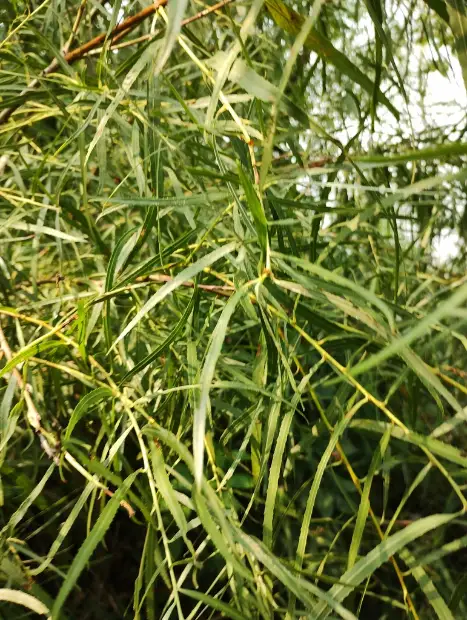
Sandbar willow

Photo: Carlos Domínguez-Rodríguez, CC BY 4.0, via iNaturalist · Montreal, Quebec, Canadá, 2024-08-16

Shrubs and vines · Native to Quebec

Sandbar willow

Salix interior Salicaceae

Sandbar willow is a suckering, multi-stemmed shrub with very narrow, silky-edged leaves that are 16 to 18 times as long as wide. It forms thickets along shores and gravel bars, with slender, flexible stems that sway in wind. Catkins open in spring, male and female on separate plants, followed by cottony seed. The fine leaves cast light shade, so other plants grow beneath it.

Latin
Salix interior
Rowlee · family Salicaceae · also Salix exigua subsp. interior (Rowlee) Cronquist; Salix longifolia Muhl.
English
Sandbar willow
riverbank willow
French
Saule de l'intérieur
saule intérieur
Kanien'kéha (Mohawk)
ó:se'
Genus-level: kanienkeha.org vocabulary glosses ó:se' simply as 'willow'; no species is distinguished.
Anishinaabemowin (Ojibwe)
oziisigobiminzh
oziisigobiminzhiig (plural)
Genus-level only. The Ojibwe People's Dictionary glosses oziisigobiminzh (na) as 'a willow' and classifies it as Salix spp.; this is a general willow word, not specific to sandbar willow (Salix interior).

Through the year

Sandbar willow in every season.

Story

The history of sandbar willow.

Sandbar willow grows along rivers, lakeshores, ditches and gravel bars across most of Canada and much of North America. It spreads by root suckers into dense colonies that hold banks against erosion, and it is often one of the first woody plants on newly deposited sand and silt. The species is native and widespread in Quebec.

The name interior was published by Rowlee, and the plant has often been treated as a subspecies of Salix exigua, so older references list it under that name. Willows in general have long been used by Indigenous peoples for cordage, baskets and other crafts. Sandbar willow has been planted for streambank and shoreline stabilization and is recognized in gardens, including with the Royal Horticultural Society's Award of Garden Merit for Salix exigua.

Sources: VASCAN: Salix interior · Wikipedia: Salix exigua · Lady Bird Johnson Wildflower Center: Salix interior

Characteristics

The plant at a glance.

Height2 to 5 m in a garden; up to 7 m in the wild
SpreadForms colonies by suckers; individual clumps 2 to 4 m wide
HabitMulti-stemmed, thicket-forming deciduous shrub
Bloom timeApril to May here
FlowersYellow-green to reddish catkins, male and female on separate plants
FoliageVery narrow, silky-green lanceolate leaves 4 to 12 cm long
FruitClusters of capsules releasing tiny seeds in white silk
HardinessZone 2
LightFull sun to part shade
MoistureMoist to wet; tolerates dry soil
Spread behaviourSpreads by basal shoots and root suckers into colonies
Native rangeMost of North America except the far north and parts of the southeast
Quebec statusNative

In the Flight Path Garden

Where it grows here.

ZonesRain Garden #2
How many3
Planted2025

In Rain Garden #2 the suckering roots stabilize wet soil and take up excess water, and the early catkins feed native bees. The fine foliage lets light through to plants beneath.

Wildlife

Who uses it.

  • The early catkins give pollen and nectar to native bees, and the Lady Bird Johnson Wildflower Center lists the plant as having special value to native bees and bumble bees.
  • Willows support butterfly and moth caterpillars, and Salix exigua is recorded as a host for several butterfly species.
  • Thickets give cover for birds and small mammals along wet edges.

Sources: Lady Bird Johnson Wildflower Center: Salix interior · Wikipedia: Salix exigua

Care

What to do, season by season.

Spring

Pull or mow suckers that escape the intended bed edge as new growth starts. Plant in moist soil with full sun for the best growth.

Summer

Water in the first season, after which wet ground needs little attention.

Fall

Leave leaf litter in place as mulch.

Winter

Cut back a third of the oldest stems in late winter to renew the shrub if it becomes leggy.

Relations

Knowledge and use.

Nothing recorded yet from a source we can cite.