Dorval and the West Island · Tiohtià:ke
Eco de l’OuestLow-mow lawns and eco gardens Book a consult
← All plants
Purple willow

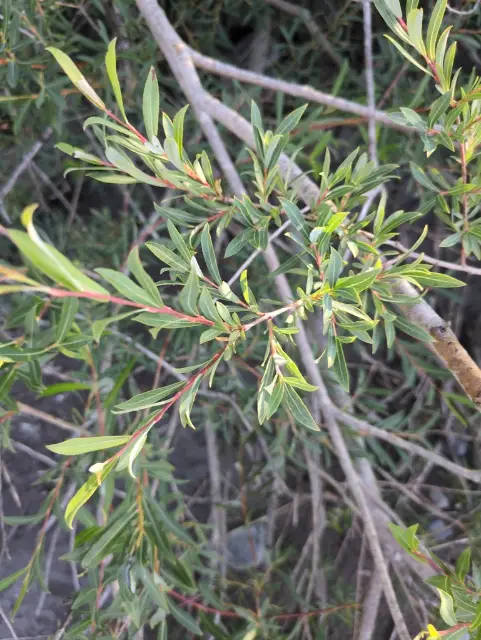
Photo: reuvenm (no rights reserved), CC0, via iNaturalist · Port Hope, ON L1A 1B3, Canada, 2025-07-23

Shrubs and vines · Introduced from Europe and North Africa

Purple willow

Salix purpurea Salicaceae

Purple willow is a multi-stemmed shrub about 5 m tall with smooth grey bark and slender, flexible twigs that are often yellowish or tinged purple. Its leaves are narrow, pale dull green and unusually for a willow often held in opposite pairs. Narrow catkins about 3 cm long appear before the leaves in spring. It is the willow traditionally cut for basketry.

Latin
Salix purpurea
L. · family Salicaceae
English
Purple willow
basket willow, purple osier, purple-osier willow
French
Saule pourpre
osier, osier rouge
Kanien'kéha (Mohawk)
ó:se'
Genus-level: kanienkeha.org vocabulary glosses ó:se' simply as 'willow'; no species is distinguished.
Anishinaabemowin (Ojibwe)
oziisigobiminzh
Ojibwe People's Dictionary glosses it as 'a willow' (Salix spp.), so it names willows in general and not this European species specifically; animate noun (na).

Through the year

Purple willow in every season.

Story

The history of purple willow.

Purple willow is native to southern Europe and North Africa, reaching north to Denmark and east to Turkey and the Baltic states. It grows in bright, very wet sites on base-rich, low-fertility soil, and supports many insects, with 247 associated species recorded in Britain, including 209 insects.

The genus name Salix comes from an old Indo-European word for willow, and purpurea refers to purple tints in the flowers, stems or leaves. The shrub has long been cut for basket making and is still harvested for that use, sometimes sold as 'Brittany Green' willow. Its weeping form 'Pendula' has the Royal Horticultural Society's Award of Garden Merit.

Sources: Wikipedia: Salix purpurea · VASCAN: Salix purpurea

Where it comes from

How it got to Canada.

Native rangeSouthern Europe and North Africa, north to Denmark and east to Turkey and the Baltic states

Purple willow has been carried to many parts of the world, mostly as an ornamental and as basketry stock, and it has naturalized in wetlands in North America. VASCAN records it as introduced in British Columbia, Alberta, Ontario, Quebec, the Maritimes and Newfoundland. The sources checked did not give a date or person for its arrival in Quebec, and did not list it as invasive in Quebec.

Sources: VASCAN: Salix purpurea · Wikipedia: Salix purpurea

Characteristics

The plant at a glance.

HeightAbout 5 m
SpreadSeveral metres over time with multiple stems
HabitMulti-stemmed shrub with flexible, slender twigs
Bloom timeApril, before the leaves
FlowersNarrow cylindrical catkins about 3 cm long; male with red anthers and yellow pollen
FoliageNarrow, pale dull green leaves, often opposite; they turn black when harvested
FruitSmall capsules with fluffy seed
HardinessHardy in Montréal's zone 5a
LightFull sun
MoistureMoist to wet
Spread behaviourMulti-stemmed; naturalizes in wetlands in North America
Native rangeSouthern Europe and North Africa
Quebec statusIntroduced, naturalized

In the Flight Path Garden

Where it grows here.

ZonesBack Ornamental Border
How manyNot recorded
PlantedBefore 2025

In the back Ornamental Border it gives early catkins and a fine-textured screen for pollinators and insects in a bed that stays moist.

Wildlife

Who uses it.

  • Willows in general support many insects; 209 insect species are recorded on purple willow in Britain.
  • The early catkins offer pollen and nectar in spring.
  • Deer resistance was not found in the sources checked.

Sources: Wikipedia: Salix purpurea

Care

What to do, season by season.

Spring

Prune right after the catkins finish. Cutting stems hard to near the base every year or two keeps the shrub dense and produces long, supple rods.

Summer

Keep the soil consistently moist, especially in the first two summers.

Fall

Leave the leaves under the shrub as mulch and check that no suckers or seedlings are escaping into nearby wet areas.

Winter

No protection needed. Winter is a good time to harvest rods for craft work.

Relations

Knowledge and use.

Purple willow has long been used for basket making and is still harvested for that purpose, as 'Brittany Green' willow.

Source: Wikipedia: Salix purpurea