Dorval and the West Island · Tiohtià:ke
Eco de l’OuestLow-mow lawns and eco gardens Book a consult
← All plants
Wild thyme

Photo: Petr Hudeček, CC BY 4.0, via iNaturalist · 671, Island, 2025-07-18

Flowers and groundcovers · Introduced from Europe

Wild thyme

Thymus serpyllum Lamiaceae

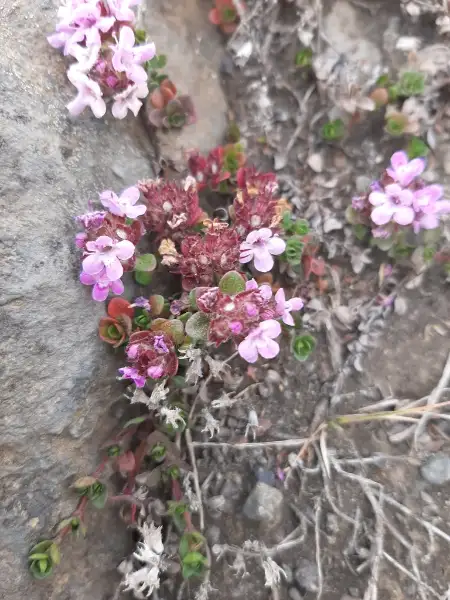
Wild thyme is a low, mat-forming evergreen subshrub with creeping woody stems and tiny, aromatic oval leaves. Dense heads of small lilac-pink to magenta flowers cover the mat in early summer. It tolerates light foot traffic, and the foliage releases a strong thyme scent when stepped on. It stays low year-round, bronzing slightly in cold weather.

Latin
Thymus serpyllum
L. · family Lamiaceae · also Often sold under this name for Thymus praecox, T. pulegioides or related creeping thymes
English
Wild thyme
mother of thyme, creeping thyme, breckland thyme
Kanien'kéha (Mohawk)
Name not yet recorded
This is a European species, and no Kanien'kéha name is attested. The Greenbelt Indigenous Botanical Survey species list has no thyme entry.
Anishinaabemowin (Ojibwe)
Name not yet recorded
This is a European species. The Ojibwe People's Dictionary search for thyme returned no entries, and the Greenbelt survey has no thyme page.

Through the year

Wild thyme in every season.

Story

The history of wild thyme.

Wild thyme is native to most of Europe and North Africa, where it grows on thin soils, sandy heaths, rocky outcrops, banks and roadsides. It is one of the plants on which large blue and common blue butterfly caterpillars feed. VASCAN has no accepted Thymus serpyllum for Canada and treats creeping thymes such as T. pulegioides (present in Quebec) and T. praecox as the names in use, so plants sold as T. serpyllum may belong to one of these.

The name serpyllum is an old Latin word for creeping thyme, and the plant has long been used as a mild-flavoured culinary herb and to upholster fragrant herb seats. It is grown today as a ground cover, a rock garden plant and a low-traffic lawn substitute.

Sources: Wikipedia: Thymus serpyllum · VASCAN: Thymus pulegioides · Missouri Botanical Garden: Thymus serpyllum

Where it comes from

How it got to Canada.

Native rangeEurope and North Africa

Creeping thymes came to North America as herb and rock-garden plants and are widely grown in Canadian gardens. VASCAN records the related Thymus pulegioides in Quebec, but a specific introduction date for Thymus serpyllum was not found. No invasive listing for it was found for Quebec.

Sources: VASCAN: Thymus pulegioides · Wikipedia: Thymus serpyllum

Characteristics

The plant at a glance.

Height5 to 10 cm
Spread20 to 30 cm per plant, knitting into a mat
HabitProstrate, mat-forming evergreen subshrub
Bloom timeJune to July
FlowersTiny, tubular, two-lipped, lilac-pink to magenta, in dense heads
FoliageEvergreen, oval leaves up to 8 mm, fragrant
FruitTiny dry nutlets
HardinessZone 4
LightFull sun
MoistureDry to medium; needs sharp drainage
Spread behaviourCreeping stems that root as they spread
Native rangeEurope and North Africa
Quebec statusNot native, cultivated

In the Flight Path Garden

Where it grows here.

ZonesMeadow and Alternative Lawn Bed · St. Lawrence Lowlands Eco Mix Lawn
How many54
Planted2023 and 2026

It carpets the dry, sunny parts of the Meadow and Alternative Lawn bed and the Eco Mix Lawn with low flowers that bees use, and it takes light foot traffic.

Wildlife

Who uses it.

  • Bees and butterflies visit the flowers in early summer.
  • In Europe the plant is a caterpillar food plant for the large blue and common blue butterflies.
  • It tolerates deer, drought and poor soil.

Sources: Wikipedia: Thymus serpyllum · Missouri Botanical Garden: Thymus serpyllum

Care

What to do, season by season.

Spring

Rake off winter debris, trim any dead stems and fill gaps with divisions. Keep taller grass and weeds from shading the mat.

Summer

Water new plants until rooted, then leave them dry. Avoid mowing during bloom to protect bees.

Fall

Do not fertilize. A light shear after flowering keeps the mat tight.

Winter

Evergreen and hardy under snow. Avoid piling salt-laden snow on it and keep drainage sharp, since wet winter soil rots the roots.

Relations

Knowledge and use.

Nothing recorded yet from a source we can cite.