Dorval and the West Island · Tiohtià:ke
Eco de l’OuestLow-mow lawns and eco gardens Book a consult
← All plants
Blue vervain

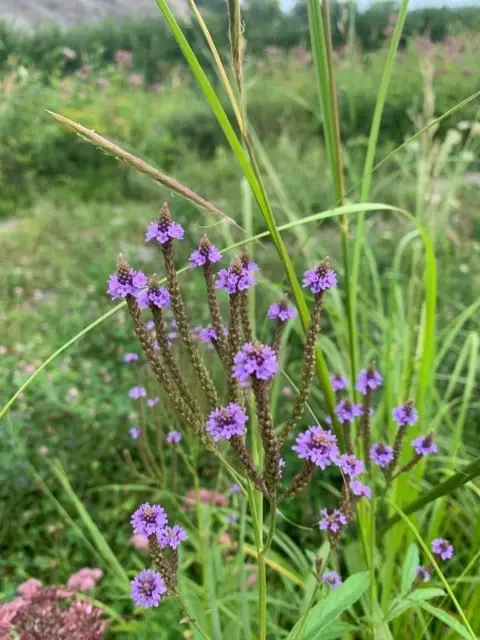
Photo: kallummcdonald (no rights reserved), CC0, via iNaturalist · Chutes-Montmorency, Quebec City, QC, CA, 2022-08-30

Flowers and groundcovers · Native to Quebec

Blue vervain

Verbena hastata Verbenaceae

Blue vervain is a tall, stiff, upright perennial with branched stems that end in slender candelabra-like spikes. Small blue-purple flowers open in a ring that climbs from the bottom of each spike to the tip, so only a few are open at once. The toothed, lance-shaped leaves are opposite on square stems. It blooms in the second half of summer, when many bees are looking for nectar.

Latin
Verbena hastata
L. · family Verbenaceae · also Verbena paniculata Lam.
English
Blue vervain
swamp vervain, swamp verbena, American vervain, simpler's joy
French
Verveine hastée
verveine scabre
Kanien'kéha (Mohawk)
Name not yet recorded
No Kanien'kéha name was found. A site search of the Greenbelt Indigenous Botanical Survey returned no blue vervain species page.
Anishinaabemowin (Ojibwe)
Name not yet recorded
The Ojibwe People's Dictionary search for 'blue vervain' returned no entry for vervain or Verbena hastata, and the Greenbelt Indigenous Botanical Survey has no page for it.

Through the year

Blue vervain in every season.

Story

The history of blue vervain.

Blue vervain grows in wet meadows, river bottomlands, stream banks, slough edges, fields and waste areas across most of the United States and southern Canada, including Quebec. It sometimes forms small colonies, and NatureServe rates it Secure. Its flowers are visited by bees, and it is a larval host for the common buckeye butterfly, the verbena moth and the verbena bud moth.

The epithet hastata is Latin for spear-shaped, referring to the leaf base. Common names include American vervain, swamp verbena and simpler's joy. It has a long history of traditional medicinal reputation, but this guide gives no use instructions.

Sources: Wikipedia: Verbena hastata · Lady Bird Johnson Wildflower Center: Verbena hastata · VASCAN: Verbena hastata

Characteristics

The plant at a glance.

Height60 to 150 cm
Spread30 to 75 cm
HabitUpright, clumping, branched perennial
Bloom timeJuly to September
FlowersSmall blue-purple flowers in slender spikes, opening from the bottom up
FoliageOpposite, toothed, lance-shaped leaves on square stems
FruitSmall nutlets in dry spikes
HardinessZone 3
LightFull sun to part shade
MoistureMoist to wet; tolerates average soil
Spread behaviourSpreads slowly by rhizomes and self-sows
Native rangeMost of the United States and southern Canada from British Columbia to Nova Scotia
Quebec statusNative

In the Flight Path Garden

Where it grows here.

ZonesSt. Lawrence Lowlands Demonstration Garden
How many10
Planted2026

It adds height and late-season flowers for bees and other pollinators, and tolerates both wet and average soil. Its upright form suits borders where runoff collects.

Wildlife

Who uses it.

  • Pollinated by bumble bees, specialist bees, other bees and butterflies.
  • Larval host for the common buckeye butterfly, the verbena moth and the verbena bud moth.
  • Seeds feed songbirds such as cardinals, sparrows and juncos, and most mammals avoid the bitter foliage.

Sources: NC State Extension Plant Toolbox: Verbena hastata · Wikipedia: Verbena hastata

Care

What to do, season by season.

Spring

Cut back old stems and divide crowded clumps once new growth shows.

Summer

Pinch the tops in early summer for a bushier, shorter plant. Water during extended dry spells.

Fall

Leave seed spikes standing for birds.

Winter

Leave stems through winter and cut them back in spring.

Relations

Knowledge and use.

Nothing recorded yet from a source we can cite.