Dorval and the West Island · Tiohtià:ke
Eco de l’OuestLow-mow lawns and eco gardens Book a consult
← All plants
Big bluestem

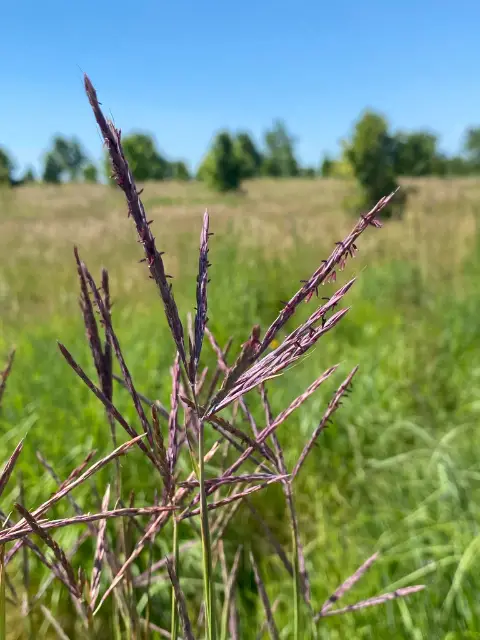
Photo: Julie Lapalme, CC BY 4.0, via iNaturalist · Montréal, QC, CA, 2025-08-01

Grasses, sedges and ferns · Native to Quebec

Big bluestem

Andropogon gerardi Poaceae

Big bluestem is a tall, warm-season bunchgrass with blue-green leaves and stems that stay low through spring and shoot up in midsummer. In late summer the flowering stems rise well above the foliage and end in two to six finger-like spikes, often in a three-part cluster that looks like a turkey's foot. In fall the whole plant turns copper, russet and maroon. The dry stems stand through most of the winter.

Latin
Andropogon gerardi
Vitman · family Poaceae · also Andropogon gerardii (common spelling); Andropogon furcatus Muhlenberg; Andropogon provincialis Lamarck nom. illeg.
English
Big bluestem
Tall bluestem, turkeyfoot
French
Barbon de Gérard
Barbon à épis digités, barbon fourchu
Kanien'kéha (Mohawk)
Name not yet recorded
No attested Kanien'kéha name found. Checked the Greenbelt Indigenous Botanical Survey species index, which does not include big bluestem.
Anishinaabemowin (Ojibwe)
Name not yet recorded
No attested Anishinaabemowin name found. Checked the Ojibwe People's Dictionary (search 'bluestem') and Huron Smith's Ethnobotany of the Ojibwe Indians (1932), which has no Andropogon entry.

Through the year

Big bluestem in every season.

Story

The history of big bluestem.

Big bluestem ranges across the grasslands of central and eastern North America, from Quebec and Maine west to Saskatchewan and Montana. It was a dominant grass of the tallgrass prairie, growing in low meadows, prairies, open woods, sand plains and along railways. Its fibrous roots reach 1.8 to 3 m deep, which gives it high drought tolerance, and it is adapted to fire. It shelters at least two dozen species of songbirds and feeds the caterpillars of several skippers.

Fulgenzio Vitman named the species in 1792 in honour of the French botanist Louis Gérard, which is why its Quebec French name is barbon de Gérard. Andropogon comes from Greek words meaning bearded man. Cattle eat it eagerly, and overgrazing reduced it across much of its range. It is the state grass of Illinois and Missouri and the official prairie grass of Manitoba, and it is widely sown in prairie restoration.

Sources: Wikipedia: Andropogon gerardi · Lady Bird Johnson Wildflower Center: Andropogon gerardii · Minnesota Wildflowers: Big Bluestem · VASCAN: Andropogon gerardi

Characteristics

The plant at a glance.

Height1.2 to 2.4 m in flower
Spread60 to 90 cm
HabitUpright, arching clumping bunchgrass
Bloom timeAugust to September
FlowersTwo to six finger-like spikes 5 to 10 cm long, purplish-bronze, often in a turkey-foot cluster
FoliageFlat blue-green leaves up to 45 cm long; copper to russet in fall
FruitSmall grains carried on hairy spikelets, shed in fall
HardinessZone 3
LightFull sun
MoistureDry to moist; tolerates clay and sand
Spread behaviourClumping, widening slowly from short rhizomes; self-sows modestly
Native rangeCentral and eastern North America, from Quebec and Maine to Saskatchewan and Montana, south to Mexico
Quebec statusNative

In the Flight Path Garden

Where it grows here.

ZonesSt. Lawrence Lowlands Demonstration Garden · Meadow and Alternative Lawn Bed
How many18
Planted2026

Eighteen plants of big bluestem give height and winter structure to the sunny meadow plantings, and their deep roots build soil and hold up in drought. The grass also supplies cover for birds and food for skipper caterpillars.

Wildlife

Who uses it.

  • Larval host for the Delaware skipper, dusted skipper and common wood-nymph.
  • Provides nesting and winter cover for at least 24 species of songbirds.
  • Highly deer resistant and tolerant of road salt.

Sources: Lady Bird Johnson Wildflower Center: Andropogon gerardii · NC State Extension Plant Toolbox: Andropogon gerardii

Care

What to do, season by season.

Spring

Cut last year's stems to 10 to 15 cm in April before new growth appears. New shoots emerge late, often not until late May, so mark the clumps.

Summer

Water young plants in their first summer only; established clumps need no watering or fertilizer, and rich soil makes them flop.

Fall

Leave the stems standing for colour, seed and bird cover.

Winter

No care needed; the standing stems hold snow and shelter insects.

Relations

Knowledge and use.

Nothing recorded yet from a source we can cite.