Dorval and the West Island · Tiohtià:ke
Eco de l’OuestLow-mow lawns and eco gardens Book a consult
← All plants
Purple angelica

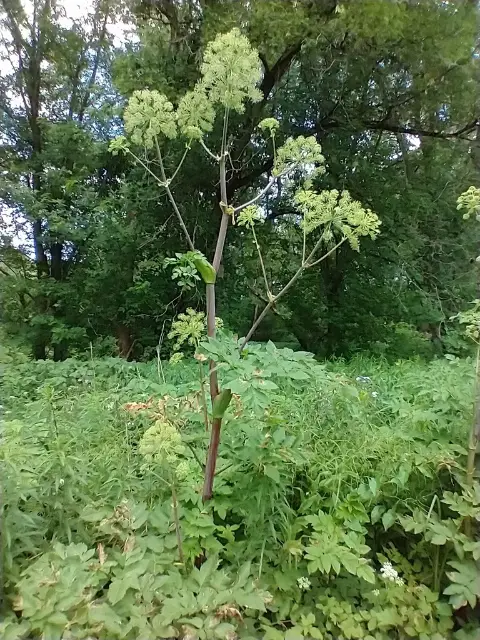
Photo: Tom Norton, CC BY 4.0, via iNaturalist · Burlington, VT 05408, USA, 2022-06-17

Flowers and groundcovers · Native to Quebec

Purple angelica

Angelica atropurpurea Apiaceae

Purple angelica is a very tall perennial with a stout, hollow, purple stem and large, bold compound leaves. Rounded umbels of white to greenish flowers, up to 20 cm across, open in late spring to early summer. It reaches about 1.8 m. It is a plant of wet, calcium-rich ground and gives a strong architectural presence in a damp bed.

Latin
Angelica atropurpurea
L. · family Apiaceae · also Angelica laurentiana Fernald; Archangelica atropurpurea (L.) Hoffm.
English
Purple angelica
purple-stemmed angelica, great angelica, dark-purple alexanders
French
Angélique pourpre
angélique noire-pourprée, angélique pourpre foncé
Kanien'kéha (Mohawk)
Name not yet recorded
The Greenbelt Indigenous Botanical Survey species list (pages 1 to 10) has no angelica entry. No other citable Kanien'kéha source was found.
Anishinaabemowin (Ojibwe)
Name not yet recorded
Not listed on the Greenbelt Indigenous Botanical Survey, and the Ojibwe People's Dictionary search for 'angelica' returned no entries. No other citable source was found.

Through the year

Purple angelica in every season.

Story

The history of purple angelica.

Purple angelica grows in eastern North America from eastern Canada and New England south to North Carolina and west to Minnesota, Iowa and Tennessee. It favours swampy, calcareous habitats with steady moisture. VASCAN lists it as native in Quebec and the Atlantic provinces. It is a host plant for black swallowtail and short-tailed swallowtail caterpillars, and small bees take nectar from the flowers.

The common names refer to the purple stems, and 'masterwort' to its historical use as a medicinal plant. Early American settlers boiled and candied the plant, and Europeans believed it could cure alcoholism. Wikipedia also records Indigenous medicinal and ceremonial uses, for example among Creek peoples.

Sources: Wikipedia: Angelica atropurpurea · VASCAN: Angelica atropurpurea

Characteristics

The plant at a glance.

HeightUp to about 1.8 m
SpreadAbout 1 m
HabitTall, erect perennial with a hollow purple stem
Bloom timeLate spring to early summer
FlowersWhite to greenish umbels up to 20 cm across, with as many as 40 rays
FoliageLarge compound leaves with 3 to 5 toothed leaflets; lower leaves up to 60 cm wide
FruitDry, winged fruits in the umbel
HardinessHardy in Montréal's zone 5a
LightFull sun to part shade
MoistureConsistently moist to wet
Spread behaviourClump-forming; reproduces by seed
Native rangeEastern North America, from eastern Canada and New England south to North Carolina and west to Minnesota, Iowa and Tennessee
Quebec statusNative

In the Flight Path Garden

Where it grows here.

ZonesHügelkultur Garden
How many20 planted; all died, to be replanted
Planted2023

Planted in the Hügelkultur Garden as a tall, damp-loving umbel for swallowtails and small bees. The first planting died, and it is due to be replanted.

Wildlife

Who uses it.

  • Host plant for black swallowtail and short-tailed swallowtail caterpillars, plus several moth species.
  • The nectar of the flowers attracts small bees.
  • Deer resistance was not confirmed in the sources checked.

Sources: Wikipedia: Angelica atropurpurea

Care

What to do, season by season.

Spring

Plant in moist soil that never dries out. Fresh foliage emerges in April and May.

Summer

Water deeply in dry weather. Stake only if the plant sits in sheltered shade and grows lanky.

Fall

Leave the seed heads for winter interest and let some seed drop to renew the stand.

Winter

No protection needed. Cut back the dead stalks in early spring.

Relations

Knowledge and use.

Wikipedia records Creek peoples using purple angelica medicinally and ceremonially, and notes early American settlers boiled and candied the plant. No Kanien'kéha or Anishinaabemowin source for this species was found.

Source: Wikipedia: Angelica atropurpurea