Dorval and the West Island · Tiohtià:ke
Eco de l’OuestLow-mow lawns and eco gardens Book a consult
← All plants
Canada wild ginger

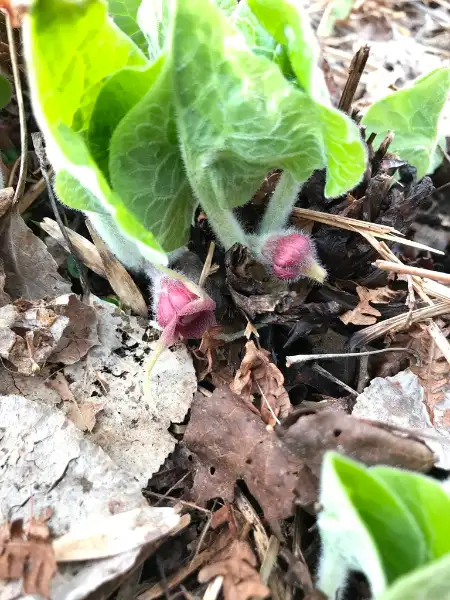
Photo: allan7 (no rights reserved), CC0, via iNaturalist · Red River, Thunder Bay, ON, CA, 2020-05-22

Flowers and groundcovers · Native to Quebec

Canada wild ginger

Asarum canadense Aristolochiaceae

Canada wild ginger is a low woodland groundcover with pairs of large, velvety, kidney-shaped leaves on hairy stalks about 15 cm tall. A small brownish-purple, three-lobed flower sits at ground level between the leaf stalks in spring, so it is easily missed. Fleshy shallow rhizomes knit the plants into a slow, dense carpet. The leaves die back in winter.

Latin
Asarum canadense
L. · family Aristolochiaceae · also Asarum acuminatum (Ashe) E.P.Bicknell; Asarum reflexum E.P.Bicknell; Asarum rubrocinctum Peattie
English
Canada wild ginger
wild ginger
French
Asaret du Canada
asaret gingembre, gingembre sauvage, snicroûte
Kanien'kéha (Mohawk)
tsyonehskwénrye
Name given for Wild Ginger on the Greenbelt Indigenous Botanical Survey wild ginger page.
Anishinaabemowin (Ojibwe)
namepin
nmepin
Names given for Wild Ginger on the Greenbelt survey wild ginger page. The Ojibwe People's Dictionary search for Asarum and wild ginger returned no matching entry.

Through the year

Canada wild ginger in every season.

Story

The history of canada wild ginger.

Wild ginger grows in the understory of deciduous forests across eastern North America, from the Great Plains to the Atlantic coast and from southeastern Canada south to the Fall Line. Its seeds carry an oil-rich appendage that ants eat, and the ants carry the seeds up to about 36 metres from the parent. The seeds need warm and then cold periods before they germinate, and the plant spreads mostly by rhizomes.

Wild ginger holds a place in Haudenosaunee and Anishinaabe knowledge as a seasoning, a ceremonial plant and a medicine, and many nations recorded its use. The roots contain aristolochic acid, so eating the plant is not recommended. It is now widely suggested as a native shade groundcover.

Sources: Wikipedia: Asarum canadense · VASCAN: Asarum canadense · Greenbelt Indigenous Botanical Survey: Wild Ginger

Characteristics

The plant at a glance.

Height10 to 20 cm
Spread30 cm or more, slowly widening
HabitLow, mat-forming woodland perennial
Bloom timeApril to June
FlowersSmall tan to purple, three-lobed flower at ground level
FoliageVelvety, kidney-shaped leaves, deciduous in cold climates
FruitCapsule with ant-dispersed seeds
HardinessZone 3
LightPart to full shade
MoistureMoist, rich, well-drained
Spread behaviourSpreads slowly by shallow rhizomes
Native rangeEastern North America, southeastern Canada to the southeastern US
Quebec statusNative

In the Flight Path Garden

Where it grows here.

ZonesMini-Forest
How many5
Planted2025

In the Mini-Forest it carpets the shaded floor under shrubs and trees with a native groundcover that suppresses weeds.

Wildlife

Who uses it.

  • Seeds are dispersed by ants, which carry them to new sites.
  • Rodents and slugs eat seeds and may damage young plants.
  • Leaves are rarely browsed by deer.

Sources: Wikipedia: Asarum canadense

Care

What to do, season by season.

Spring

Plant in humus-rich soil and keep moist while roots settle. Watch for slug damage on new leaves.

Summer

Water in dry spells; the plant wilts in dry shade.

Fall

Leave fallen leaves as mulch. Divide rhizome pieces with a dormant bud if you want to extend the patch.

Winter

Leaves die back; a leaf mulch protects the rhizomes.

Relations

Knowledge and use.

The Greenbelt Indigenous Botanical Survey describes wild ginger as a cultural keystone species for Indigenous peoples of the Great Lakes region, used as a flavouring and for spiritual protection, and records Alyssa General and Elder Brian Peltier speaking about its uses. It advises fall harvest only in small amounts because the rootstock supports both medicine and reproduction.

Source: Greenbelt Indigenous Botanical Survey: Wild Ginger