Dorval and the West Island · Tiohtià:ke
Eco de l’OuestLow-mow lawns and eco gardens Book a consult
← All plants
Swamp milkweed

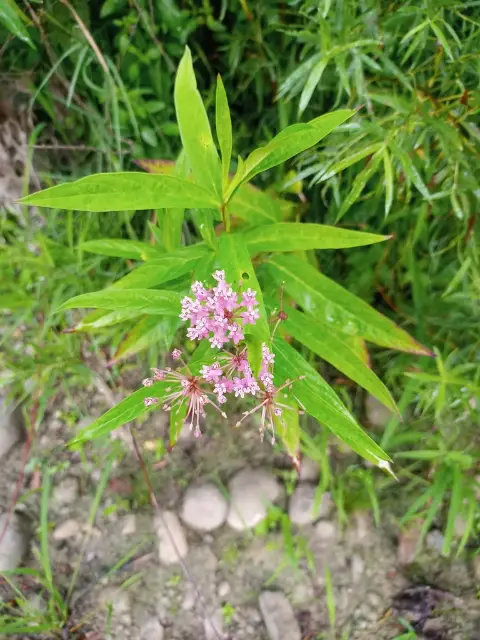
Photo: reuvenm (no rights reserved), CC0, via iNaturalist · Stoneybrook, London, ON, Canada, 2020-07-29

Flowers and groundcovers · Native to Quebec

Swamp milkweed

Asclepias incarnata Apocynaceae

Swamp milkweed is an upright, branching perennial about 1 to 1.5 m tall with narrow, lance-shaped opposite leaves. Rounded clusters of fragrant pink to mauve flowers open in mid-summer and draw a steady crowd of butterflies and bees. Slim tan seed pods split in fall to release seeds on silky parachutes. It is far better behaved than common milkweed and forms a tidy clump.

Latin
Asclepias incarnata
L. · family Apocynaceae
English
Swamp milkweed
French
Asclépiade incarnate
asclépiade rouge
Kanien'kéha (Mohawk)
Tsikenetshehwén:ta
Otshehwén:ta; Kanon'tíneken's
Genus-level: Canadian Geographic gives Tsikenetshehwén:ta for common milkweed (Asclepias syriaca); NYS 4-H gives Otshehwén:ta and Kanon'tíneken's for 'Milkweed' without a species. Neither names swamp milkweed specifically.
Anishinaabemowin (Ojibwe)
Bagizowin
Zasab
The LTBB Native Plants Initiative guide lists Bagizowin for swamp milkweed (Asclepias incarnata), citing Densmore 1974 and Meeker et al. (GLIFWC 1993), and Zasab citing Meeker et al. (GLIFWC 1993). Modern-style spelling as given in the LTBB guide (Odawa/Anishinaabemowin); both are second-hand citations of the primary books, which were not opened.

Through the year

Swamp milkweed in every season.

Story

The history of swamp milkweed.

Swamp milkweed grows in wet meadows, swamps, marshes, shores and riparian zones across eastern and central North America, from Manitoba and Quebec south to Georgia and Texas. It is a preferred host for monarch butterflies: in preference tests, over half of the eggs laid went on this species. Seeds germinate slowly and plants are often short-lived, commonly 2 to 5 years in gardens.

The Greenbelt Indigenous Botanical Survey cites Alyssa General recording that swamp milkweed stems were used as fibre for netting. The genus name Asclepias honours Asklepios, the Greek god of medicine, and incarnata refers to the flesh-pink flowers.

Sources: Lady Bird Johnson Wildflower Center: Asclepias incarnata · Wikipedia: Asclepias incarnata · Greenbelt Indigenous Botanical Survey: Common Milkweed

Characteristics

The plant at a glance.

Height1 to 1.5 m
Spread50 to 90 cm
HabitUpright, branching clump
Bloom timeJune to August
FlowersFragrant rounded clusters, light pink to mauve, sometimes white
FoliageOpposite, narrow, lance-shaped leaves 8 to 15 cm long
FruitSlim tan-brown follicles with silky-haired seeds
HardinessZone 3
LightFull sun to part shade
MoistureMoist to wet; tolerates average garden soil
Spread behaviourClumping; self-sows lightly
Native rangeManitoba and Quebec south to Georgia and Texas
Quebec statusNative

In the Flight Path Garden

Where it grows here.

ZonesRain Garden #2 · Rain Garden #1
How many10
Planted2026

It adds mid-summer colour to wet or average beds and feeds monarch caterpillars and many pollinators. It forms a clump rather than running through the garden.

Wildlife

Who uses it.

  • Host plant for monarch caterpillars, and the monarch's preferred milkweed for egg-laying.
  • Flowers are visited by native bees, bumble bees, honey bees, butterflies and hummingbirds.
  • Aphids often colonize stems and can be rinsed off with water.

Sources: Lady Bird Johnson Wildflower Center: Asclepias incarnata · Wikipedia: Asclepias incarnata

Care

What to do, season by season.

Spring

Plants emerge late, often in late May, so mark the spot and do not disturb the crown. Mulch lightly.

Summer

Keep soil moist in drought and rinse aphids off with a hard spray of water. Do not cut the plant back while caterpillars are feeding.

Fall

Leave seed pods to open, or collect seed for sowing, which needs cold stratification.

Winter

Leave the stalks standing through winter and cut them back in spring.

Relations

Knowledge and use.

The Greenbelt Indigenous Botanical Survey cites Alyssa General recording that swamp milkweed stems were used as fibre for making nets, and that spring greens and buds were fried and eaten.

Source: Greenbelt Indigenous Botanical Survey: Common Milkweed