Dorval and the West Island · Tiohtià:ke
Eco de l’OuestLow-mow lawns and eco gardens Book a consult
← All plants
Yellow birch

Photo: Loïc Mathieu, CC BY 4.0, via iNaturalist · Saint-Guillaume-Nord, QC, Canada, 2024-06-24

Trees · Native to Quebec

Yellow birch

Betula alleghaniensis Betulaceae

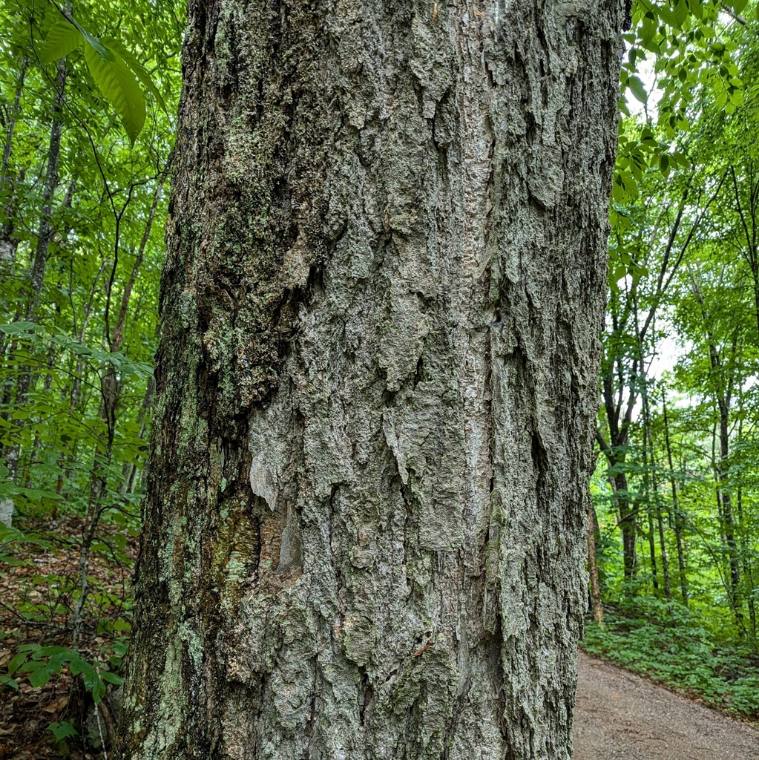
Yellow birch is a large, long-lived birch with shiny bronze-gold bark that peels in thin horizontal curls. Forest-grown trees are tall and slender, while open-grown trees spread into a broad, candelabra-like crown. The dull green leaves turn clear yellow in autumn, and crushed twigs and leaves smell faintly of wintergreen. Catkins open in spring, and the winter bark and bare branches keep the tree interesting through the cold months.

Latin
Betula alleghaniensis
Britton · family Betulaceae · also Betula lutea F. Michaux
English
Yellow birch
swamp birch
French
Bouleau jaune
merisier jaune, bouleau des Alléghanys
Kanien'kéha (Mohawk)
tsyotsyó:ren
Listed by the Greenbelt Indigenous Botanical Survey on its page for paper birch, black birch, yellow birch and speckled alder.
Anishinaabemowin (Ojibwe)
wiinizik
wiinizikoog (plural)
The Greenbelt Indigenous Botanical Survey gives wiinizik with the plural -oog. The Ojibwe People's Dictionary lists wiinizik as an animate noun glossed 'a yellow birch' (Betula alleghaniensis).

Through the year

Yellow birch in every season.

Story

The history of yellow birch.

Yellow birch is native to cool, moist woods, north-facing slopes and swamps across eastern Canada and the northeastern United States, and it is the largest birch of that region. Deer, moose and many birds use its seeds and twigs, although heavy deer numbers can limit young trees from regenerating. In Quebec it is common and holds a prominent place as the provincial tree.

The species was first described as Betula lutea in 1812 and renamed Betula alleghaniensis by Nathaniel Lord Britton in 1904, a name that refers to the Allegheny Mountains. It is the most important birch for lumber in eastern Canada, used for furniture and flooring, and its sap can be boiled to a syrup with a wintergreen flavour. The Greenbelt Indigenous Botanical Survey notes that about half of all yellow birches in North America grow in Quebec, which is why it is the provincial tree.

Sources: Wikipedia: Betula alleghaniensis · Greenbelt Indigenous Botanical Survey: Paper Birch, Black Birch, Yellow Birch, and Speckled Alder · VASCAN: Betula alleghaniensis

Characteristics

The plant at a glance.

Height18 to 24 m in the wild; slower in a garden
Spread8 to 12 m for open-grown trees
HabitTall, slender in forest; broad, candelabra-like crown in the open
Bloom timeMay
FlowersMale and female catkins on the same tree, wind-pollinated
FoliageDull green above, paler below, wintergreen scent when crushed; clear yellow in fall
FruitSmall winged nutlets in upright, cone-like catkins, shed in fall
HardinessZone 3
LightPart shade to shade
MoistureMoist to wet; poor in hot, dry sites
Spread behaviourSingle or multi-stem trunk; spreads by wind-blown seed
Native rangeEastern Canada and the northeastern United States, south through the Appalachians
Quebec statusNative

In the Flight Path Garden

Where it grows here.

ZonesMini-Forest
How many3
Planted2025

In the Mini-Forest yellow birch is a future canopy tree that suits the cool, moist, shaded conditions of a woodland planting. Its peeling bark and seed crop add winter interest and food for birds.

Wildlife

Who uses it.

  • Deer, moose and many birds eat the seeds, buds and twigs, and the tree gives nesting and foraging structure in woodland.
  • Birches in general host many moth and butterfly caterpillars, which feed nesting songbirds.
  • Deer browse young trees, so seedlings and saplings benefit from protection.

Sources: Wikipedia: Betula alleghaniensis · Lady Bird Johnson Wildflower Center: Betula alleghaniensis

Care

What to do, season by season.

Spring

Plant in cool, moist, shaded soil with a mulch ring kept off the trunk. Prune only dead wood, and avoid pruning when sap is rising.

Summer

Water deeply in dry weeks during the first three summers, because the tree does poorly in heat and drought.

Fall

Leave the fallen leaves under the tree as mulch and watch the autumn colour.

Winter

Protect young trunks and twigs from deer with a cage or wrap, and keep road salt away from the root zone.

Relations

Knowledge and use.

The Greenbelt Indigenous Botanical Survey records that yellow birch sap has been tapped to make birch beer, and that its dry bark curls are light to carry and are used as kindling by hunters and travellers. The same page notes that the wood has been used to make corn pounders, and cites Waugh for the use of birch sap, twigs, leaves and buds in flavourful teas and drinks.

Source: Greenbelt Indigenous Botanical Survey: Paper Birch, Black Birch, Yellow Birch, and Speckled Alder