Dorval and the West Island · Tiohtià:ke
Eco de l’OuestLow-mow lawns and eco gardens Book a consult
← All plants
Sallow sedge

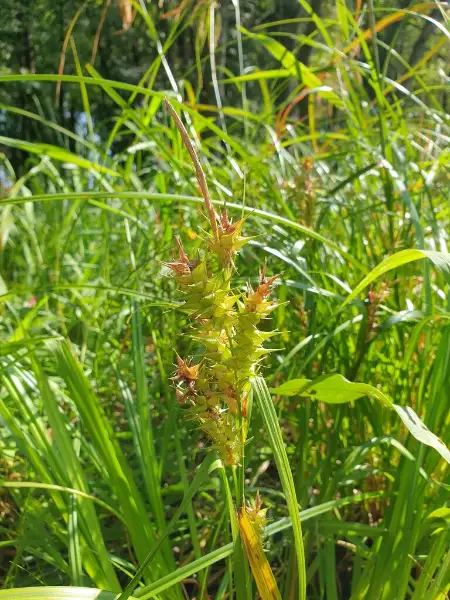
Photo: elacroix-carignan (no rights reserved), CC0, via iNaturalist · Montérégie, QC, Canada, 2024-09-11

Grasses, sedges and ferns · Native to Quebec

Sallow sedge

Carex lurida Cyperaceae

Sallow sedge forms clumps of bright yellow-green, arching leaves about half the height of the flowering stems. The distinctive feature is the large, bottlebrush-shaped fruiting spikes, lime green at first and golden brown as they ripen. It is happiest in wet soil and tolerates a few centimetres of standing water. The seed heads stay ornamental through summer into fall.

Latin
Carex lurida
Wahlenb. · family Cyperaceae · also Carex tentaculata Muhl. ex Willd.; Carex lurida var. gracilis (Boott) L.H. Bailey
English
Sallow sedge
bottlebrush sedge, shallow sedge, lurid sedge
French
Carex luisant
Kanien'kéha (Mohawk)
Name not yet recorded
No Kanien'kéha name for this sedge was found. A search of the Greenbelt Indigenous Botanical Survey returned only site pages, not a species page for Carex lurida.
Anishinaabemowin (Ojibwe)
Name not yet recorded
The Ojibwe People's Dictionary search for 'sedge' returned no results, and no species-specific Anishinaabemowin name for Carex lurida was found.

Through the year

Sallow sedge in every season.

Story

The history of sallow sedge.

Sallow sedge grows in sedge meadows, swamps, ditches and other marshy places in eastern North America, from eastern Canada south to the Gulf coast and west to the Midwest. It forms tussocks and spreads slowly by short rhizomes. In Quebec it is native, and it is rated of Least Concern by the IUCN.

Carex lurida was described by Göran Wahlenberg, and the epithet lurida means pale yellow or sallow, a reference to the pale spikes. It has several older synonyms, including Carex tentaculata. Its range extends south to Central and South America, and it has been introduced to New Zealand.

Sources: Wikipedia: Carex lurida · VASCAN: Carex lurida · Plant Native: Sallow Sedge

Characteristics

The plant at a glance.

Height30 to 90 cm
Spread30 to 60 cm, slowly widening
HabitTufted, tussock-forming clumps with arching leaves
Bloom timeMay to July
FlowersSmall wind-pollinated flowers in spikes
FoliageBright yellow-green, narrow, arching
FruitLarge bottlebrush-shaped spikes, lime green turning golden brown, June to August
HardinessZone 3
LightFull sun to part shade
MoistureWet to moist; tolerates standing water several centimetres deep
Spread behaviourSlow, by short rhizomes; not aggressive
Native rangeEastern North America, from Ontario and Quebec south to Florida and west to Wisconsin and Missouri
Quebec statusNative

In the Flight Path Garden

Where it grows here.

ZonesRain Garden #1
How many5
Planted2025

In Rain Garden #1 the clumps tolerate wet feet and standing water, so they take in runoff and keep the soil covered. Their bottlebrush seed heads add texture next to broader-leaved plants.

Wildlife

Who uses it.

  • Seeds are eaten by waterfowl and wetland birds.
  • Larval host for satyr butterflies.
  • Dense clumps give nesting cover for birds such as the marsh wren and common yellowthroat.

Sources: Plant Native: Sallow Sedge

Care

What to do, season by season.

Spring

Cut back last year's leaves before new growth. Divide clumps now if they have outgrown their space.

Summer

Keep the soil moist in the first season; established plants need little care in wet ground.

Fall

Leave the seed heads standing for late-season interest and bird food.

Winter

Leave the clumps standing, and tidy in early spring instead.

Relations

Knowledge and use.

Nothing recorded yet from a source we can cite.