Dorval and the West Island · Tiohtià:ke
Eco de l’OuestLow-mow lawns and eco gardens Book a consult
← All plants
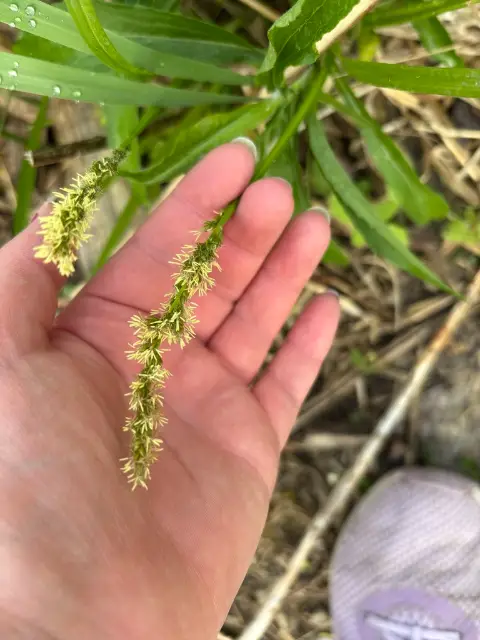
Common fox sedge

Photo: kristinpiston (no rights reserved), CC0, via iNaturalist · Commissioners Rd E, London, ON, CA, 2025-05-13

Grasses, sedges and ferns · Native to Quebec

Common fox sedge

Carex stipata Cyperaceae

Common fox sedge is a tuft-forming sedge with coarse, wrinkled leaves and stout, spongy stems. The seed heads are dense, spike-like clusters of bristly, beaked fruits with a spongy base, packed along the upper stem. It forms clumps and does not spread by runners. It is one of the most common sedges in wet soils across northern North America.

Latin
Carex stipata
Muhl. ex Willd. · family Cyperaceae
English
Common fox sedge
awl-fruited sedge, prickly sedge, swamp sedge
French
Laiche épaisse
carex stipité, carex spongieux
Kanien'kéha (Mohawk)
Name not yet recorded
The Greenbelt Indigenous Botanical Survey species list has no sedge entry, and no other citable Kanien'kéha source was found.
Anishinaabemowin (Ojibwe)
Name not yet recorded
The Ojibwe People's Dictionary search for sedge returned no entries, and the Greenbelt survey has no sedge page.

Through the year

Common fox sedge in every season.

Story

The history of common fox sedge.

Common fox sedge grows in river banks, floodplain forest, wet meadows, marshes, swamps, ditches and pond and stream margins. It is a wetland obligate, found across Canada and the northern United States and also in East Asia, and it is rated Least Concern. In Quebec it is native.

Carex stipata was described by Muhlenberg and published by Willdenow in the early 1800s; stipata refers to the tightly crowded flower spikes. Its seeds are eaten by wetland birds, and it makes up about a quarter of the swamp sparrow's diet according to the Lady Bird Johnson Wildflower Center.

Sources: Wikipedia: Carex stipata · Minnesota Wildflowers: Awl-fruited sedge · Lady Bird Johnson Wildflower Center: Carex stipata · VASCAN: Carex stipata

Characteristics

The plant at a glance.

Height60 to 100 cm
Spread30 to 60 cm
HabitTufted clump with coarse, arching leaves
Bloom timeMay to June
FlowersInconspicuous, in dense spike-like clusters with 15 to 25 branches
FoliageCoarse, wrinkled, linear leaves with parallel veins
FruitBeaked achenes with a spongy base, ripening June to July
HardinessZone 3
LightFull sun to part shade
MoistureWet to moist; tolerates standing water
Spread behaviourClumping; no runners; self-sows in wet soil
Native rangeAcross Canada and the northern United States, south to Florida, Louisiana, Kansas and California; also East Asia
Quebec statusNative

In the Flight Path Garden

Where it grows here.

ZonesRain Garden #1
How many5
Planted2025

In Rain Garden #1 it holds soil in the wettest spots and takes up runoff, and it provides seed and cover for birds.

Wildlife

Who uses it.

  • Seeds feed wetland birds, and the sedge makes up about a quarter of the swamp sparrow's diet.
  • The dense tufts give nesting and hiding cover along pond banks and stream edges.
  • Sedges generally resist deer browsing.

Sources: Lady Bird Johnson Wildflower Center: Carex stipata

Care

What to do, season by season.

Spring

Cut last year's leaves to a few centimetres above the crown in early spring before new growth starts.

Summer

Keep the soil wet in the first season. Established clumps handle seasonal flooding and need no feeding.

Fall

Leave the seed heads standing for birds. Divide congested clumps in fall if you want more plants.

Winter

Hardy in Montréal winters. The tufts catch snow and add form to the bed.

Relations

Knowledge and use.

Nothing recorded yet from a source we can cite.