Dorval and the West Island · Tiohtià:ke
Eco de l’OuestLow-mow lawns and eco gardens Book a consult
← All plants
White turtlehead

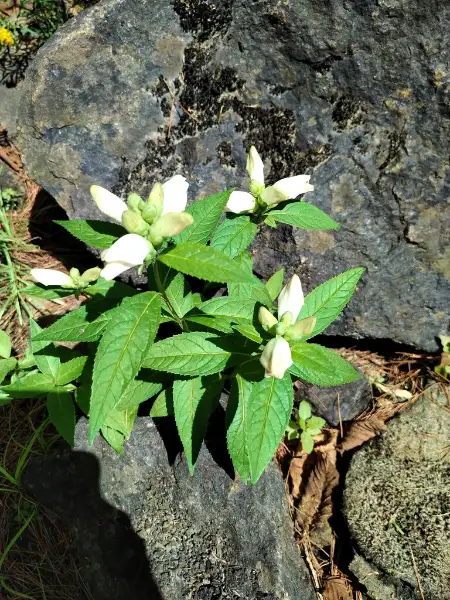
Photo: troz (no rights reserved), CC0, via iNaturalist · Haliburton County, ON, Canada, 2025-08-30

Flowers and groundcovers · Native to Quebec

White turtlehead

Chelone glabra Plantaginaceae

White turtlehead is an upright perennial with dark green, toothed, opposite leaves on stiff stems. In late summer to early fall it carries tight spikes of white, sometimes pink-tinged, tubular flowers shaped like the head of a turtle. It forms a slowly widening clump in wet soil and blooms when many other plants are finished. The seed capsules and stems stand through early winter.

Latin
Chelone glabra
L. · family Plantaginaceae · also Chelone chlorantha Porter & Britton; Chelone glabra var. linifolia; Chelone glabra var. dilatata
English
White turtlehead
snakehead
French
Galane glabre
Kanien'kéha (Mohawk)
Name not yet recorded
No Kanien'kéha name was found. The Greenbelt Indigenous Botanical Survey has no turtlehead page at the address checked.
Anishinaabemowin (Ojibwe)
Name not yet recorded
The Ojibwe People's Dictionary search for 'turtlehead' returned no results, and no other citable Anishinaabemowin name was found.

Through the year

White turtlehead in every season.

Story

The history of white turtlehead.

White turtlehead grows in brushy marshes, stream banks, wet ditches, low meadows and swampy woods from Newfoundland and Labrador to Manitoba and south to Georgia. It is the main host plant on which the Baltimore checkerspot butterfly lays its eggs. In Quebec it is native.

The genus name Chelone is Greek for tortoise, a reference to the flower's resemblance to a turtle's head, and a Greek myth tells of a nymph named Chelone turned into a tortoise. DNA studies have placed the plant in the plantain family, Plantaginaceae, instead of the older figwort family.

Sources: Wikipedia: Chelone glabra · Lady Bird Johnson Wildflower Center: Chelone glabra · VASCAN: Chelone glabra

Characteristics

The plant at a glance.

Height30 to 120 cm
Spread45 to 60 cm
HabitUpright, clumping perennial
Bloom timeAugust to September
FlowersTubular, white to pinkish, in dense terminal spikes
FoliageOpposite, toothed, dark green leaves
FruitDry capsules with winged seeds
HardinessZone 3
LightFull sun to part shade
MoistureMoist to wet
Spread behaviourClumping; expands slowly, divides easily
Native rangeNewfoundland and Labrador to Manitoba, south to Georgia and Arkansas
Quebec statusNative

In the Flight Path Garden

Where it grows here.

ZonesRain Garden #2
How many45
Planted2025

In Rain Garden #2 it thrives in wet soil and gives late-season flowers for pollinators. It also supports the Baltimore checkerspot, a butterfly that depends on it.

Wildlife

Who uses it.

  • Host plant for the Baltimore checkerspot butterfly (Euphydryas phaeton), which lays eggs on it.
  • Flowers attract bumble bees, butterflies and hummingbirds.
  • Deer browse it, so protect young plants where deer are common.

Sources: Lady Bird Johnson Wildflower Center: Chelone glabra · Wikipedia: Chelone glabra

Care

What to do, season by season.

Spring

Divide clumps in early spring, spacing divisions about 45 cm apart. Cut back old stems as new shoots emerge.

Summer

Keep the soil moist; the plant wilts in dry spells. Pinching stems in early summer makes plants bushier and shorter.

Fall

Leave the seed capsules for winter interest.

Winter

Leave stems standing and cut them back in early spring.

Relations

Knowledge and use.

Nothing recorded yet from a source we can cite.