Dorval and the West Island · Tiohtià:ke
Eco de l’OuestLow-mow lawns and eco gardens Book a consult
← All plants
Tufted hairgrass

Photo: Richard Littauer, CC BY 4.0, via iNaturalist · Tasman, NZ-NE, NZ, 2025-01-21

Grasses, sedges and ferns · Native to Quebec

Tufted hairgrass

Deschampsia cespitosa Poaceae

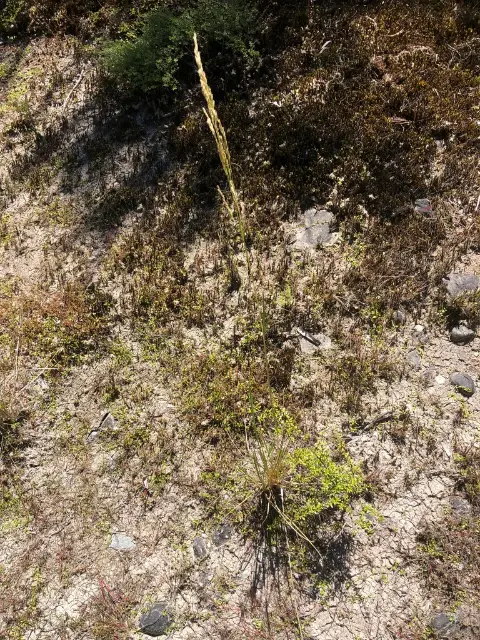
Tufted hairgrass forms a dense, fountain-like clump of fine, dark green, grooved leaves that stay mostly evergreen at the base. In June it throws up a cloud of tiny hair-like flower heads, purplish-green at first and tawny later. The airy plumes bleach gold and last into late fall. Plants are about 1 to 1.4 m tall in flower.

Latin
Deschampsia cespitosa
(L.) P. Beauv. · family Poaceae · also Aira cespitosa L.
English
Tufted hairgrass
small-flowered ticklegrass, tussock grass
French
Deschampsie cespiteuse
canche cespiteuse, canche gazonnante
Kanien'kéha (Mohawk)
Name not yet recorded
The Greenbelt Indigenous Botanical Survey species list (pages 1 to 10) has no hairgrass entry. No other citable Kanien'kéha source was found.
Anishinaabemowin (Ojibwe)
Name not yet recorded
Not listed on the Greenbelt Indigenous Botanical Survey. No Ojibwe People's Dictionary entry for this species was identified, and no other citable source was found.

Through the year

Tufted hairgrass in every season.

Story

The history of tufted hairgrass.

Tufted hairgrass grows across Canada and south to North Carolina, the Great Lakes and the western mountains, and is also found in Eurasia, Africa and Australasia. It likes moist to wet ground in meadows, sandy or rocky shores, bogs and fens, and is a dominant grass in mountain meadows. It is the larval host for the Juba skipper and the umber skipper.

It is a widely planted ornamental grass in gardens, and cultivars such as 'Goldschleier' and 'Goldtau' have won the Royal Horticultural Society's Award of Garden Merit. In Britain it is a major component of grassland communities.

Sources: Wikipedia: Deschampsia cespitosa · Lady Bird Johnson Wildflower Center: Deschampsia cespitosa · VASCAN: Deschampsia cespitosa

'Goldgehänge'

A compact selection that carries airy golden-yellow flower heads on a clump of shiny green leaves, roughly 30 to 60 cm tall and wide. Retailer listings give hardiness as zones 4 to 9; its breeder and year of selection were not found in the sources checked.

Characteristics

The plant at a glance.

HeightSpecies up to 1.4 m in flower; 'Goldgehänge' about 30 to 60 cm
SpreadClump 30 to 60 cm wide
HabitDense tufted fountain of arching leaves
Bloom timeJune to August
FlowersOpen, airy panicles with hair-like awns, purplish-green to tawny, bleaching gold
FoliageDark green, deeply grooved leaves, mostly evergreen at the base
FruitTiny grains held in the plumes
HardinessHardy in Montréal's zone 5a; 'Goldgehänge' listed as zones 4 to 9
LightPart shade to sun
MoistureMoist to wet; tolerates poorly drained soil
Spread behaviourClumping
Native rangeTranscontinental across Canada, south to North Carolina, the Great Lakes and western mountains; also Eurasia
Quebec statusNative

In the Flight Path Garden

Where it grows here.

ZonesSt. Lawrence Lowlands Demonstration Garden
How manyabout 70 including 12 'Goldgehänge'
Planted2023 and 2026

It gives the beds a fine-textured, long-lasting grass that thrives in damp, partly shaded ground and holds its plumes through winter.

Wildlife

Who uses it.

  • Larval host for the Juba skipper and the umber skipper butterflies.
  • Birds eat the seeds, and the dense tussocks give cover to small animals.
  • It is browsed as forage in mountain meadows, and deer resistance was not confirmed.

Sources: Wikipedia: Deschampsia cespitosa · Lady Bird Johnson Wildflower Center: Deschampsia cespitosa

Care

What to do, season by season.

Spring

Cut the old clump back to about 10 cm in early spring before new growth starts.

Summer

Water in prolonged drought, since it prefers moist soil. The plumes appear from June onward.

Fall

Leave the seed heads standing for winter structure and for birds.

Winter

No protection needed. Divide overgrown clumps in spring or early fall if they open in the centre.

Relations

Knowledge and use.

Nothing recorded yet from a source we can cite.