Dorval and the West Island · Tiohtià:ke
Eco de l’OuestLow-mow lawns and eco gardens Book a consult
← All plants
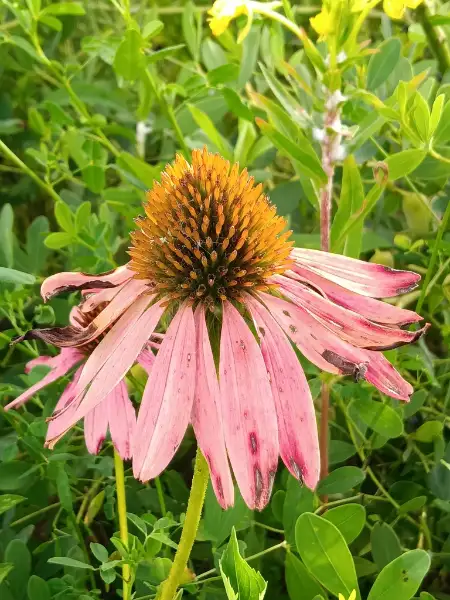
Eastern purple coneflower

Photo: skylar_schell (no rights reserved), CC0, via iNaturalist · Parke County, IN, USA, 2025-08-12

Flowers and groundcovers · Native to the central and eastern United States, not Quebec

Eastern purple coneflower

Echinacea purpurea Asteraceae

Eastern purple coneflower is a clump-forming perennial with stiff stems and oval to lance-shaped, rough leaves. Large daisy-like flowers have a prominent domed, orange-brown central cone surrounded by drooping pink-purple petals. It blooms through the second half of summer and into early fall. The seed cones stay upright through winter.

Latin
Echinacea purpurea
(L.) Moench · family Asteraceae · also Rudbeckia purpurea L.; Brauneria purpurea (L.) Britton
English
Eastern purple coneflower
purple coneflower, broad-leaved purple coneflower
French
Échinacée pourpre
Kanien'kéha (Mohawk)
Name not yet recorded
The Greenbelt Indigenous Botanical Survey species list has no coneflower entry, and no other citable Kanien'kéha name was found.
Anishinaabemowin (Ojibwe)
Name not yet recorded
The Ojibwe People's Dictionary search for coneflower returned no entries, and the Greenbelt survey has no coneflower page.

Through the year

Eastern purple coneflower in every season.

Story

The history of eastern purple coneflower.

Eastern purple coneflower is native to the central and eastern United States, centred on the Ozarks, the Mississippi Valley and the Ohio Valley, where it grows in dry open woods, prairies and barrens. VASCAN lists it as introduced in Quebec and in Ontario, so it is a garden escape here, not part of the original flora.

Linnaeus named it Rudbeckia purpurea in 1753, and Conrad Moench moved it to Echinacea in 1794. Echinacea comes from the Greek for spiny one, a reference to the spiny cone that looks like a sea urchin. It is a long-popular garden plant and several cultivars have earned awards from the Royal Horticultural Society.

Sources: Wikipedia: Echinacea purpurea · VASCAN: Echinacea purpurea · Lady Bird Johnson Wildflower Center: Echinacea purpurea

'Fragrant Angel'

A white-flowered coneflower with a frilly ring of overlapping petals around an orange-gold cone and large blooms up to about 10 cm across. It was found as a sport of 'Ruby Giant' and introduced to the trade by Terra Nova Nurseries in 2005. It ranked first for pollinators in the 2018 to 2020 Echinacea trial at Mt. Cuba Center.

Where it comes from

How it got to Canada.

Native rangeCentral and eastern United States, from Georgia to northeastern Texas and north to Ohio, Illinois and Iowa

The species is native to the American Midwest and South and was brought into northern gardens as an ornamental and herb. VASCAN records it as introduced in Quebec and Ontario, meaning it grows here from cultivation and is not part of the original flora. It is widely grown in gardens, and no invasive listing was found for Quebec.

Sources: VASCAN: Echinacea purpurea · Lady Bird Johnson Wildflower Center: Echinacea purpurea

Characteristics

The plant at a glance.

Height60 to 120 cm; 'Fragrant Angel' about 75 cm
Spread30 to 60 cm
HabitUpright clump
Bloom timeJuly to September
FlowersPink-purple drooping rays around a domed orange-brown cone, 7 to 15 cm across; 'Fragrant Angel' is white
FoliageOval to lance-shaped, rough leaves 5 to 30 cm long
FruitSpiny seed cones with small achenes
HardinessZone 3
LightFull sun to part shade
MoistureMedium to dry; well-drained soil
Spread behaviourClumping; self-sows moderately
Native rangeCentral and eastern United States
Quebec statusNot native, cultivated

In the Flight Path Garden

Where it grows here.

ZonesBack Ornamental Border · Meadow and Alternative Lawn Bed
How many18 plugs, 2 'Fragrant Angel'
Planted2026

It keeps the back Ornamental Border and the Meadow and Alternative Lawn bed in flower from midsummer into fall and gives bees and finches food, while the seed heads provide winter structure.

Wildlife

Who uses it.

  • Bumblebees, honey bees, monarchs and swallowtail butterflies visit the flowers, and it is a special-value plant for native bees.
  • Finches eat and disperse the seed from the standing cones.
  • It is not deer resistant, so young plants may need protection.

Sources: Lady Bird Johnson Wildflower Center: Echinacea purpurea · Wikipedia: Echinacea purpurea

Care

What to do, season by season.

Spring

Plant plugs in full sun and cut old stems to the ground once new basal leaves show. Protect young shoots from deer and rabbits.

Summer

Water new plants regularly; established clumps tolerate drought. Deadheading prolongs bloom.

Fall

Leave seed heads standing for finches. Divide clumps in spring or early fall every few years.

Winter

Hardy in Montréal. Avoid wet, heavy soil, which rots the crown, especially for cultivars like 'Fragrant Angel'.

Relations

Knowledge and use.

Wikipedia notes that Native Americans used purple coneflower in traditional medicine. This guide gives no instructions, and no Kanien'kéha or Anishinaabemowin source was found.

Source: Wikipedia: Echinacea purpurea