Dorval and the West Island · Tiohtià:ke
Eco de l’OuestLow-mow lawns and eco gardens Book a consult
← All plants
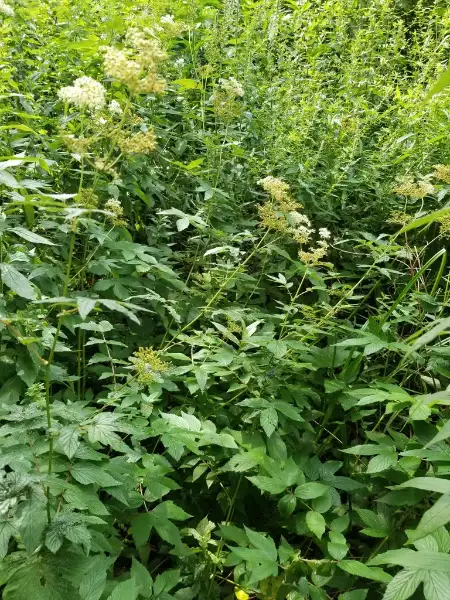
Meadowsweet

Photo: S Boisvert, CC BY 4.0, via iNaturalist · Bas-Saint-Laurent, QC, Canada, 2024-08-03

Flowers and groundcovers · Introduced from Europe and western Asia

Meadowsweet

Filipendula ulmaria Rosaceae

Meadowsweet is a tall perennial with erect, furrowed, reddish stems and dark green, deeply cut leaves that look somewhat like elm leaves. In summer it carries dense, frothy clusters of small creamy-white flowers with a sweet almond-like fragrance. It thrives in humus-rich, consistently moist soil and can seed freely. The stems die back after seed set in fall.

Latin
Filipendula ulmaria
(L.) Maxim. · family Rosaceae · also Spiraea ulmaria L.; Filipendula denudata (J. Presl & C. Presl) Fritsch
English
Meadowsweet
queen-of-the-meadow, elm queen-of-the-meadow, European meadowsweet
French
Reine-des-prés
Kanien'kéha (Mohawk)
Name not yet recorded
This is a European plant introduced to North America. The Greenbelt Indigenous Botanical Survey has no page for it, and no citable Kanien'kéha name was found.
Anishinaabemowin (Ojibwe)
Name not yet recorded
This is a European plant introduced to North America. A search of the Ojibwe People's Dictionary for 'meadowsweet' returned no results, and no citable Anishinaabemowin name was found.

Through the year

Meadowsweet in every season.

Story

The history of meadowsweet.

Meadowsweet is native to most of Europe and western Asia, where it grows in damp meadows, ditches and stream edges, and is assessed as Least Concern. In Canada it is recorded as introduced or naturalized in Quebec, Ontario, the Atlantic provinces and British Columbia, and some Midwestern US states classify it as a noxious weed.

The name meadowsweet dates from the 16th century and originally meant a plant used to flavour mead, and the epithet ulmaria means elm-like. In the 16th century Elizabeth I of England favoured it for strewing on chamber floors. In 1838 Raffaele Piria extracted salicylic acid from its buds, and the later synthetic drug aspirin takes its name from the plant's former genus, Spiraea.

Sources: Wikipedia: Filipendula ulmaria · VASCAN: Filipendula ulmaria · NC State Extension Plant Toolbox: Filipendula ulmaria

Where it comes from

How it got to Canada.

Native rangeMost of Europe and western Asia

Meadowsweet reached North America as a garden and herb plant from Europe, and it has escaped to damp ground in eastern Canada. VASCAN lists it as introduced or naturalized in Newfoundland, Prince Edward Island, New Brunswick, Nova Scotia, Quebec, Ontario and British Columbia. The date and person responsible for its arrival were not found in the sources checked. It self-seeds freely and can spread out of control in moist sites, and some Midwestern US states list it as a noxious weed. No Quebec invasive listing was found, so it should be deadheaded and kept out of natural wet areas.

Sources: VASCAN: Filipendula ulmaria · NC State Extension Plant Toolbox: Filipendula ulmaria · Wikipedia: Filipendula ulmaria

Characteristics

The plant at a glance.

Height90 to 180 cm
Spread30 to 90 cm
HabitUpright clumping perennial
Bloom timeJune to August
FlowersDense clusters of small yellowish-white to creamy flowers, sweetly fragrant
FoliageDark green, deeply cut leaves resembling elm leaves; stems reddish and furrowed
FruitSmall spirally twisted seed clusters
HardinessZone 3
LightFull sun to part shade
MoistureMoist to wet; does not tolerate dry or acid soil
Spread behaviourFreely self-seeds and can spread
Native rangeEurope and western Asia
Quebec statusIntroduced, naturalized

In the Flight Path Garden

Where it grows here.

ZonesSt. Lawrence Lowlands Demonstration Garden
How many20
Planted2026

It is a tall, fragrant, moisture-loving plant in the Lowlands Demonstration Garden, giving height and pollen-rich summer bloom in damp spots. Deadheading prevents its seedlings from spreading into wilder areas.

Wildlife

Who uses it.

  • Flowers attract bees and other pollinating insects.
  • Resistant to deer and rabbit browsing.
  • It is not a native host plant, so its value is mainly as a late-spring and summer pollen source.

Sources: NC State Extension Plant Toolbox: Filipendula ulmaria

Care

What to do, season by season.

Spring

Plant in humus-rich, moist soil and mulch to hold moisture. Divide clumps as growth begins.

Summer

Keep the soil consistently moist. Deadhead after bloom to stop self-seeding.

Fall

Cut spent stems before seeds drop if spread is a concern. Compost the seed heads rather than spreading them.

Winter

No protection is needed. Cut remaining stems back in early spring.

Relations

Knowledge and use.

In the 16th century meadowsweet was a favourite of Elizabeth I of England, who had it strewn on chamber floors, and Bronze Age sites show evidence of its use in mead or flavoured drinks. Salicylic acid extracted from its buds in 1838 led to the name aspirin.

Source: Wikipedia: Filipendula ulmaria