Dorval and the West Island · Tiohtià:ke
Eco de l’OuestLow-mow lawns and eco gardens Book a consult
← All plants
Hakone grass

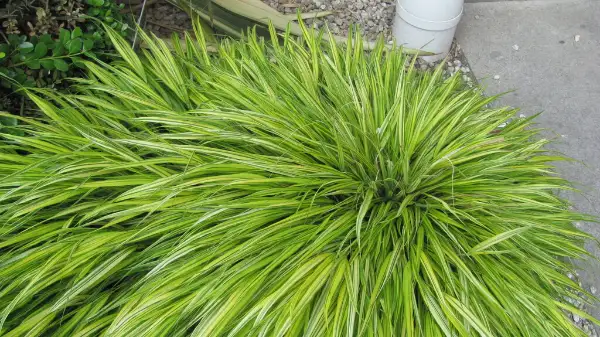
Photo: zebedeugalinha, CC BY 4.0, via iNaturalist · Glasnevin, Dublin, Irlanda, 2010-06-17

Grasses, sedges and ferns · Introduced from Japan

Hakone grass

Hakonechloa macra Poaceae

Hakone grass forms slow, cascading mounds of soft, bamboo-like leaves that arch in one direction like a waterfall. The foliage is gold or gold-striped in the cultivars grown here and glows in shade. Plants rustle in the wind, turn orange or bronze in fall and die back completely in winter. Flowers are small and inconspicuous.

Latin
Hakonechloa macra
(Makino) Makino ex Honda · family Poaceae
English
Hakone grass
Japanese forest grass
French
Herbe du Japon
herbe d'Hakone
Kanien'kéha (Mohawk)
Name not yet recorded
This is a Japanese grass. No Kanien'kéha name exists in the Greenbelt survey, and none was found elsewhere.
Anishinaabemowin (Ojibwe)
Name not yet recorded
This is a Japanese grass. No Anishinaabemowin name was found and none was invented.

Through the year

Hakone grass in every season.

Story

The history of hakone grass.

Hakonechloa macra is endemic to Japan, where it grows on wet, shaded cliffs and rocky slopes in the Mount Hakone region of Honshu. The genus is a single species. The name combines Hakone with the Greek word for grass, and macra comes from a Greek word meaning long or large.

It entered Western gardens in the 20th century. The all-green species is seldom grown; 'Aureola' became the standard garden form and was named Perennial Plant of the Year in 2009, with 'All Gold' and the red-tinged 'Beni-Kaze' as other selections.

Sources: Wikipedia: Hakonechloa · UW-Madison Extension Horticulture: Hakone grass

'Aureola'

Arching leaves striped bright golden yellow with narrow green lines, brightest in part shade. It is the most widely grown form, won the Royal Horticultural Society's Award of Garden Merit and was the Perennial Plant Association's Plant of the Year in 2009.

'All Gold'

A more upright, spiky and compact selection, about 30 to 45 cm tall, with leaves ranging from pale yellow to solid gold depending on how much sun it gets. It grows slowly.

Where it comes from

How it got to Canada.

Native rangeJapan (Honshu, around the Hakone region)

Hakone grass reached North American gardens as an ornamental shade grass during the 20th century, and the golden 'Aureola' became the popular form. It spreads slowly by rhizomes and is described as not invasive, so it stays in the bed where it is planted. No Quebec invasive listing was found in the sources reviewed.

Sources: UW-Madison Extension Horticulture: Hakone grass · Wikipedia: Hakonechloa

Characteristics

The plant at a glance.

Height30 to 50 cm
Spread45 to 60 cm
HabitSlow, cascading mound
Bloom timeAugust to September, inconspicuous
FlowersSmall, airy green panicles
FoliageNarrow, bamboo-like leaves; gold or gold-striped in cultivars; orange to bronze in fall
FruitInconspicuous
HardinessZone 4 to 5; cultivars listed as Zone 5
LightPart shade to shade; gold forms colour best in bright shade
MoistureEvenly moist, especially in spring and hot weather
Spread behaviourSlow rhizomes; not invasive
Native rangeJapan
Quebec statusNot native, cultivated

In the Flight Path Garden

Where it grows here.

ZonesOrnamental Border, Full Sun · Ornamental Border, Partial Sun
How many22 'Aureola', 3 'All Gold'
Planted2025 and 2026

In both front borders it brightens shaded ground with gold foliage and softens path edges. It is a slow, well-behaved groundcover grass.

Wildlife

Who uses it.

  • Provides little food for native wildlife, so it is best used as a shade accent among native plantings.
  • Not favoured by deer and has few pest or disease problems.
  • The dense mound gives low ground cover for small insects.

Sources: UW-Madison Extension Horticulture: Hakone grass

Care

What to do, season by season.

Spring

Cut back the dead foliage as new shoots show, and mulch with compost. Do not rush; growth starts late.

Summer

Keep the soil evenly moist and the plant out of hot afternoon sun, which scorches the leaves.

Fall

Let the leaves turn colour and leave them in place as winter protection.

Winter

Foliage dies back fully. Mulch young plants well in their first winters since the cultivars are marginal in zone 5.

Relations

Knowledge and use.

Nothing recorded yet from a source we can cite.