Dorval and the West Island · Tiohtià:ke
Eco de l’OuestLow-mow lawns and eco gardens Book a consult
← All plants
Common winterberry

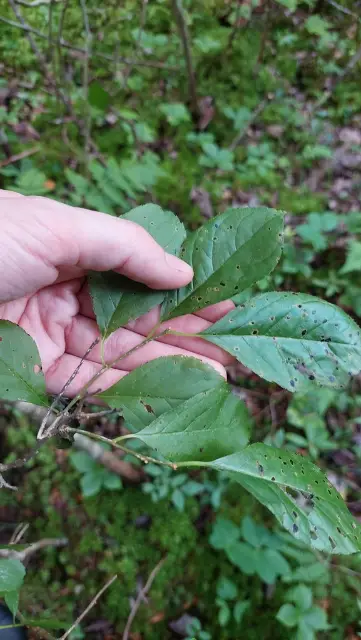
Photo: elacroix-carignan (no rights reserved), CC0, via iNaturalist · Outaouais, QC, Canada, 2026-08-15

Shrubs and vines · Native to Quebec

Common winterberry

Ilex verticillata Aquifoliaceae

Winterberry is a deciduous holly that forms a multi-stemmed shrub with dark green, toothed leaves. Small white flowers open in early summer, and on female plants they become bright red berries that colour in September. After the leaves drop, the berries stay on the bare branches into winter, which is the plant's best season. Male and female flowers grow on separate plants, so a male nearby is needed for fruit.

Latin
Ilex verticillata
(L.) A. Gray · family Aquifoliaceae · also Prinos verticillatus L. (basionym)
English
Common winterberry
Winterberry, black alder, Virginia winterberry, black holly
French
Houx verticillé
Kanien'kéha (Mohawk)
Name not yet recorded
No Kanien'kéha name found. Winterberry has no page in the Greenbelt Indigenous Botanical Survey species list (checked the full alphabetical grid).
Anishinaabemowin (Ojibwe)
aweˈnîsibûg
anîmûˈcîmînûn
Both names recorded by Huron Smith among the Wisconsin Ojibwe in 1932, in his older phonetic spelling. Smith glosses aweˈnîsibûg as 'wintergreen leaf' and anîmûˈcîmînûn as 'dog berry'. Modern double-vowel spellings were not found; the Ojibwe People's Dictionary has no entry for winterberry.

Through the year

Common winterberry in every season.

Story

The history of common winterberry.

Winterberry grows wild from Newfoundland and Nova Scotia west to Ontario and Minnesota and south to the Gulf states, mostly in swamps, wet thickets and pond edges, though it also turns up on sandy ground. Its berries hang on the branches long after other fruit is gone, and birds such as American robins eat them in late winter and early spring. It is a larval host for Henry's elfin butterfly.

Linnaeus first placed the species in the genus Prinos, and Asa Gray moved it to Ilex, the holly genus; that history is recorded in its authority, (L.) A. Gray. Older names include black alder, fever bush and Michigan holly; fever bush comes from Indigenous medicinal use of the plant. The cut berried branches are widely used in winter decorations.

Sources: Wikipedia: Ilex verticillata · Lady Bird Johnson Wildflower Center: Ilex verticillata · VASCAN: Ilex verticillata

Characteristics

The plant at a glance.

Height1.5 to 3 m, occasionally to 5 m
Spread1.5 to 3 m
HabitUpright, multi-stemmed, rounded
Bloom timeJune to July
FlowersSmall and white; male and female on separate plants
FoliageDark green, toothed, deciduous
FruitRed berries 6 to 8 mm, ripening in September and persisting into winter; female plants only
HardinessZone 3
LightFull sun to part shade
MoistureMoist to wet, acidic soil preferred
Spread behaviourClumping; slowly suckers into a thicket
Native rangeEastern North America, Newfoundland to Minnesota and south to the Gulf states
Quebec statusNative

In the Flight Path Garden

Where it grows here.

ZonesRain Garden #2
How many25
Planted2025

In Rain Garden #2 it takes the wettest ground and holds it with a dense root system, and its red winter berries feed birds when little else is left.

Wildlife

Who uses it.

  • Berries persist through winter and feed American robins and other birds in late winter and early spring.
  • Larval host for Henry's elfin butterfly.
  • Flowers provide nectar for small insects in early summer, and the dense branches give birds cover and nesting sites.

Sources: Lady Bird Johnson Wildflower Center: Ilex verticillata · Wikipedia: Ilex verticillata

Care

What to do, season by season.

Spring

Prune out dead or crossing stems before leaves open. Mulch with leaf litter to keep the soil moist and acidic.

Summer

Water during long dry spells, especially in the first two years. Check that at least one male plant is flowering near the females.

Fall

Leave the berries on the plant for birds. Cut a few berried branches for decoration if wanted.

Winter

No care needed. The berries are the main winter feature; protect young shrubs from rabbits if needed.

Relations

Knowledge and use.

Huron Smith recorded two Ojibwe names for winterberry in 1932 and listed it among plants used as medicine. The English name fever bush also comes from Indigenous medicinal use of the berries. All parts of the plant, including the berries, can cause nausea if eaten.

Source: Huron H. Smith, Ethnobotany of the Ojibwe Indians (1932) · Wikipedia: Ilex verticillata