Dorval and the West Island · Tiohtià:ke
Eco de l’OuestLow-mow lawns and eco gardens Book a consult
← All plants
Great blue lobelia

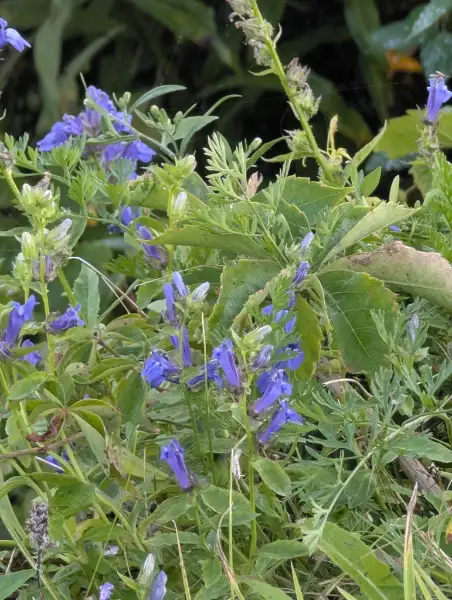
Photo: leoeuler (no rights reserved), CC0, via iNaturalist · Niagara Falls, ON L2E 7M7, Canada, 2025-09-14

Flowers and groundcovers · Native to Quebec

Great blue lobelia

Lobelia siphilitica Campanulaceae

Great blue lobelia is an upright, mostly unbranched perennial with spikes of lavender-blue tubular flowers crowded along the upper stem. It grows from a rosette of leaves, rising to about 90 cm in late summer. The flowers open from August to October, a time when few blue flowers are in bloom. It prefers constantly moist soil and is short-lived but self-sows.

Latin
Lobelia siphilitica
L. · family Campanulaceae · also Dortmanna siphilitica (L.) Kuntze; Lobelia siphilitica var. ludoviciana A. DC.
English
Great blue lobelia
blue cardinal flower, great lobelia
French
Lobélie bleue
Kanien'kéha (Mohawk)
Name not yet recorded
No Greenbelt Indigenous Botanical Survey page for lobelia was found by search, and no other citable Kanien'kéha name for this species was found.
Anishinaabemowin (Ojibwe)
Name not yet recorded
A search of the Ojibwe People's Dictionary for 'lobelia' returned no results, and no citable Anishinaabemowin name for this species was found.

Through the year

Great blue lobelia in every season.

Story

The history of great blue lobelia.

Great blue lobelia grows in swamp forests, roadside ditches, floodplains, lake margins and wet prairies from Maine to Manitoba and south to North Carolina and Texas. VASCAN records it in Quebec and Ontario. Bumblebees are the main pollinators: a bee of the right weight presses down the lower petals to reach the nectar, which lowers the stigma against its back. The plant is short-lived, lasting only a few years.

The epithet siphilitica comes from a mistaken belief, held by early European settlers, that the plant cured syphilis. The genus honours the Flemish botanist Matthias de l'Obel. Native Americans have used the plant traditionally, according to published sources.

Sources: Wikipedia: Lobelia siphilitica · VASCAN: Lobelia siphilitica · Lady Bird Johnson Wildflower Center: Lobelia siphilitica

Characteristics

The plant at a glance.

Height60 to 150 cm; often about 90 cm
Spread30 to 45 cm
HabitUpright, mostly unbranched perennial from a leaf rosette
Bloom timeAugust to October
FlowersLavender-blue tubular flowers crowded on the upper stem, with a three-lobed lower lip
FoliageAlternate, lance-shaped green leaves
FruitCapsule with many tiny seeds
HardinessZone 4
LightFull sun to part shade
MoistureMoist to wet; not drought tolerant
Spread behaviourShort-lived clumps that self-sow and form offsets
Native rangeMaine to Manitoba, south to Georgia, Texas and Colorado
Quebec statusNative

In the Flight Path Garden

Where it grows here.

ZonesSt. Lawrence Lowlands Demonstration Garden · Meadow and Alternative Lawn Bed
How many54
Planted2026

It brings late-season blue colour and bumblebee forage to moist beds, and a large planting makes a dense block that feeds pollinators into October.

Wildlife

Who uses it.

  • Special value to native bees and bumble bees, which are its main pollinators.
  • Attracts hummingbirds and birds.
  • All plant parts are poisonous if eaten in quantity, so browsers usually leave it alone.

Sources: Lady Bird Johnson Wildflower Center: Lobelia siphilitica · Wikipedia: Lobelia siphilitica

Care

What to do, season by season.

Spring

Plant in moist, humus-rich soil and mulch lightly. Divide or move offsets as growth starts.

Summer

Keep the soil moist, since the plant is not drought tolerant. Pinch stems in early summer for bushier plants if desired.

Fall

Leave some seed heads to self-sow. Rosettes form at the base for winter.

Winter

Mulch lightly over the rosettes. Cut old stems back in early spring.

Relations

Knowledge and use.

Published sources report that Native Americans traditionally used great blue lobelia, and that early European settlers believed it cured syphilis, which gave the plant its Latin name.

Source: Wikipedia: Lobelia siphilitica