Dorval and the West Island · Tiohtià:ke
Eco de l’OuestLow-mow lawns and eco gardens Book a consult
← All plants
Ostrich fern

Photo: reuvenm (no rights reserved), CC0, via iNaturalist · Joshuas Valley Park, Oakville, ON, CA, 2018-03-31

Grasses, sedges and ferns · Native to Quebec

Ostrich fern

Matteuccia struthiopteris Onocleaceae

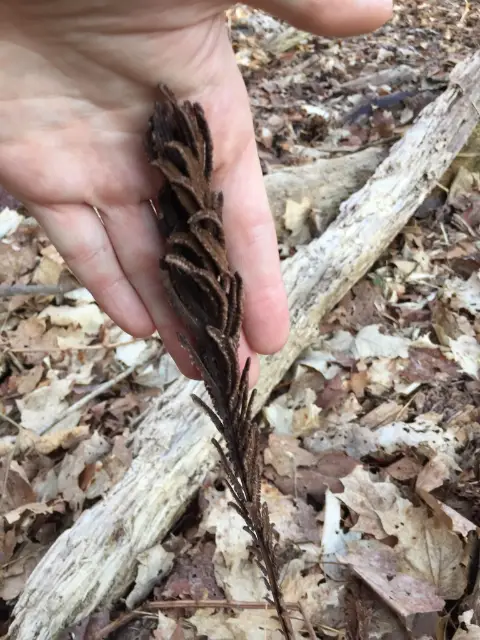
Ostrich fern forms a shuttlecock of tall, arching, plume-like sterile fronds, up to about 1.5 m, from a central crown. In autumn it sends up shorter, dark fertile fronds that stand upright over winter and release spores in early spring. It spreads by underground stolons to form colonies. The tightly coiled young fronds are the fiddleheads eaten in Quebec each spring.

Latin
Matteuccia struthiopteris
(L.) Tod. · family Onocleaceae
English
Ostrich fern
fiddlehead fern
French
Matteuccie fougère-à-l'autruche
fougère à l'autruche, fougère allemande, tête de violon
Kanien'kéha (Mohawk)
kahtehrahòn:tsi
Given on the Greenbelt Indigenous Botanical Survey page for ostrich fern; the page does not give a meaning or community.
Anishinaabemowin (Ojibwe)
zhishkwedaansan
naanaaganashk (-oon), mzise miijim
The same survey page lists naanaaganashk (-oon) as a general name for ferns and mzise miijim as a general term for fern, so those two are not specific to ostrich fern. The Ojibwe People's Dictionary search for 'fern' returned no entries.

Through the year

Ostrich fern in every season.

Story

The history of ostrich fern.

Ostrich fern grows in temperate regions of the Northern Hemisphere, across central and northern Europe, northern Asia and northern North America. It prefers moist, shaded ground and its stolons let colonies hold up to spring flooding on riverbanks. Some Lepidoptera larvae feed on it.

The genus honours the Italian neurophysiologist Carlo Matteucci, and struthiopteris combines the Greek words for ostrich and fern, for the feathery sterile fronds. The fiddleheads are a delicacy in northeastern North America, known in Quebec as têtes de violon, and must be cooked rather than eaten raw. The Greenbelt Indigenous Botanical Survey notes the fiddleheads were harvested at Six Nations of the Grand River as early as 1912.

Sources: Wikipedia: Matteuccia struthiopteris · Wikipédia: Matteucia struthiopteris · Greenbelt Indigenous Botanical Survey: ferns

Characteristics

The plant at a glance.

HeightSterile fronds 100 to 170 cm; fertile fronds 40 to 65 cm
SpreadForms colonies through stolons
HabitVase-shaped crown of arching fronds
Bloom timeDoes not flower
FrondsSterile fronds 20 to 35 cm broad, plume-like; brown scales on young fiddleheads
SporesFertile fronds develop in autumn, stand through winter and release spores in early spring
HardinessHardy in Montréal's zone 5a
LightPart shade to shade
MoistureMoist to wet
Spread behaviourLateral stolons form new crowns and dense colonies
Native rangeTemperate northern Europe, northern Asia and northern North America
Quebec statusNative

In the Flight Path Garden

Where it grows here.

ZonesMini-Forest · Hügelkultur Garden
How many23
Planted2023 and 2025

In the Mini-Forest and the Hügelkultur Garden it fills damp shaded ground under the trees with a dense, soft layer and stabilizes the soil as it spreads.

Wildlife

Who uses it.

  • Caterpillars of some Lepidoptera species eat the fronds.
  • The dense, cool foliage gives ground cover and shelter to small creatures in shade.
  • Deer resistance was not confirmed in the sources checked.

Sources: Wikipedia: Matteuccia struthiopteris

Care

What to do, season by season.

Spring

Fiddleheads emerge in April or May. Leave most of them in place, as removing too many weakens the crown. Cut back last year's brown fertile fronds once the new fronds are open.

Summer

Keep the soil moist. Leaf edges brown in dry spells, so mulch and water in drought.

Fall

Leave the fertile fronds standing, as they hold the spores through winter. Divide crowded colonies and move extra crowns to new shaded spots.

Winter

Nothing is needed; the dark fertile fronds stand above the snow.

Relations

Knowledge and use.

The Greenbelt Indigenous Botanical Survey calls ostrich fern the only fern that is edible as a spring fiddlehead vegetable and records its harvest at Six Nations of the Grand River dating to 1912. In Quebec the fiddleheads are known as têtes de violon and are a regional spring food.

Source: Greenbelt Indigenous Botanical Survey: ferns · Wikipédia: Matteucia struthiopteris