Dorval and the West Island · Tiohtià:ke
Eco de l’OuestLow-mow lawns and eco gardens Book a consult
← All plants
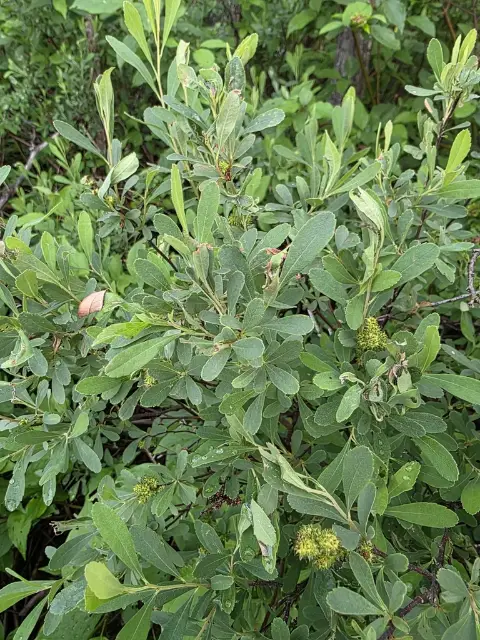
Sweet gale

Photo: carterdorscht (no rights reserved), CC0, via iNaturalist · Chapleau, ON P0M 1K0, Canada, 2025-06-29

Shrubs and vines · Native to Quebec

Sweet gale

Myrica gale Myricaceae

Sweet gale is a low, bushy deciduous shrub with grey-green leaves that are dotted with resin glands and smell strongly resinous when brushed. Small brown and reddish catkins open on bare twigs in spring, with male and female flowers usually on separate plants. It spreads by root suckers into dense clonal patches along wet edges. The twiggy brown stems and fat buds give it a tidy look through winter.

Latin
Myrica gale
L. · family Myricaceae · also Gale palustris Chevallier; Myrica gale var. subglabra (A. Chevalier) Fernald
English
Sweet gale
Bog myrtle, meadow-fern, sweet bayberry
French
Myrique baumier
Bois-sent-bon, myrice baumier, myrice galé
Kanien'kéha (Mohawk)
Name not yet recorded
No attested Kanien'kéha name found. Checked the Greenbelt Indigenous Botanical Survey species index, which does not include sweet gale.
Anishinaabemowin (Ojibwe)
Wasawasnimike
Wa'sawasni'mike
The LTBB guide gives Wasawasnimike ('yellow catkins', citing Herron 2002) and Wa'sawasni'mike (citing Meeker et al., GLIFWC 1993) for sweet gale (Myrica gale), listed as sweet gale/bayberry. Second-hand citations; the original books were not opened.

Through the year

Sweet gale in every season.

Story

The history of sweet gale.

Sweet gale grows in cool temperate regions of Eurasia and North America, from Labrador to Alaska and south to Long Island, Michigan and Oregon. It is a shrub of lake shores, stream banks, bogs, fens and swamps, often dominating the shoreline. Its roots carry nitrogen-fixing nodules that let it thrive in nutrient-poor peat, and individual plants can change sex from one year to the next.

In northwestern Europe the leaves were a main ingredient of gruit, the herb mixture used to flavour beer from the Middle Ages to the 16th century, before hops replaced it. The foliage has long served as an insect repellent, and the plant has also been used for yellow dye, candle wax and as a seasoning. One of its Quebec French names, bois-sent-bon, means sweet-smelling wood.

Sources: Wikipedia: Myrica gale · Minnesota Wildflowers: Sweet-gale · Wild Adirondacks: Sweetgale · Lady Bird Johnson Wildflower Center: Myrica gale · VASCAN: Myrica gale

Characteristics

The plant at a glance.

Height60 cm to 1.5 m
Spread1 to 1.5 m per plant, wider as colonies
HabitLow, bushy, multi-stemmed deciduous shrub
Bloom timeApril to May, before the leaves
FlowersSmall catkins; male catkins erect, 1 to 2 cm; female catkins with red stigmas; sexes usually on separate plants
FoliageGrey-green, resin-dotted, toothed near the tip; strongly fragrant when crushed
FruitSmall waxy nutlets in compact cone-like clusters
HardinessZone 2
LightFull sun to part shade
MoistureWet to moist, acidic, peaty or sandy soil
Spread behaviourSpreads by root suckers into clonal colonies
Native rangeCool temperate Eurasia and North America; Labrador to Alaska, south to Long Island, Michigan and Oregon
Quebec statusNative

In the Flight Path Garden

Where it grows here.

ZonesSt. Lawrence Lowlands Demonstration Garden
How many6
Planted2026

Sweet gale suits the wettest, poorest corners of the garden, where it holds soil with its suckering roots and adds nitrogen through its root nodules. Its aromatic leaves make it a good edging shrub along paths near low spots.

Wildlife

Who uses it.

  • Leaves are larval food for several moth species.
  • American tree sparrows, white-throated sparrows, swamp sparrows and ring-necked ducks use sweet gale stands.
  • Beavers browse the stems, and the shrub adds cover along wetland edges for water birds.

Sources: Wild Adirondacks: Sweetgale · Wikipedia: Myrica gale

Care

What to do, season by season.

Spring

Watch the catkins open on bare twigs in April. Cut out any dead stems once buds break.

Summer

Keep the soil consistently moist; sweet gale tolerates standing water but suffers in dry, alkaline soil.

Fall

Leave the leaves in place as mulch. Remove suckers only where the colony is crowding paths.

Winter

No care needed; the shrub is fully hardy in Montréal.

Relations

Knowledge and use.

Sweet gale was a key flavouring in gruit beer in northwestern Europe from the Middle Ages to the 16th century, and campers have used the leaves to keep biting insects out of tents. Wild Adirondacks notes that Indigenous groups in North America used it medicinally and for preserving, and that others extracted dyes from it.

Source: Wikipedia: Myrica gale · Wild Adirondacks: Sweetgale