Dorval and the West Island · Tiohtià:ke
Eco de l’OuestLow-mow lawns and eco gardens Book a consult
← All plants
Virginia creeper

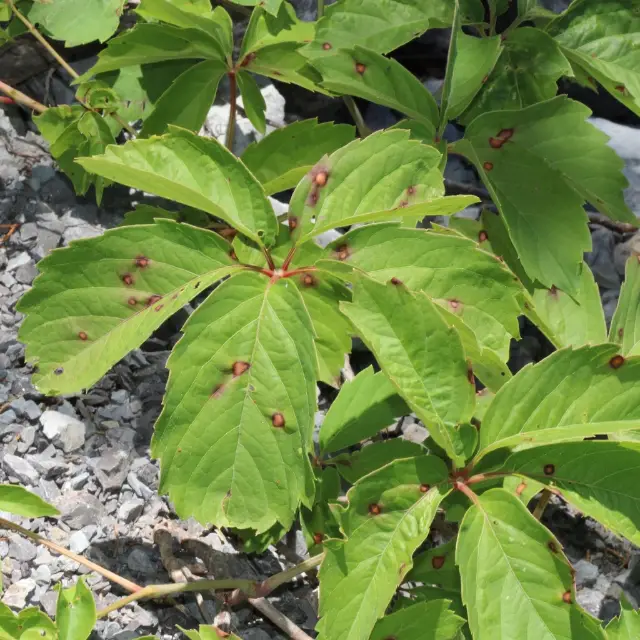
Photo: adam1420, CC BY 4.0, via iNaturalist · Campbellford, ON K0L 1L0, Canada, 2026-06-16

Shrubs and vines · Native to Quebec

Virginia creeper

Parthenocissus quinquefolia Vitaceae

Virginia creeper is a vigorous woody vine that climbs by tendrils ending in small adhesive discs. Each leaf has five toothed leaflets, which turn brilliant red, purple and mauve in autumn. Small greenish flowers appear in early summer and are followed by blue-black berries that birds eat. It also works as a groundcover, spreading over logs, slopes and the forest floor.

Latin
Parthenocissus quinquefolia
(L.) Planch. · family Vitaceae · also Ampelopsis quinquefolia (L.) Michx.; Hedera quinquefolia L.; Psedera quinquefolia (L.) Greene; Vitis quinquefolia (L.) Lam.
English
Virginia creeper
American ivy, five-leaved ivy
French
Vigne vierge
vigne vierge à cinq folioles, parthénocisse à cinq folioles
Kanien'kéha (Mohawk)
Name not yet recorded
The Greenbelt Indigenous Botanical Survey page for Virginia creeper gives no Kanien'kéha name. Wikipedia mentions a Mohawk name without a traceable source, so it is not reproduced here.
Anishinaabemowin (Ojibwe)
mnidoo- biimaakwad bebaamooded
Given by the Greenbelt Indigenous Botanical Survey for Virginia creeper, spelled as the survey writes it. The Ojibwe People's Dictionary has no entry for Virginia creeper.

Through the year

Virginia creeper in every season.

Story

The history of virginia creeper.

Virginia creeper is native to eastern and central North America and grows in woodland edges, thickets, fences and rocky slopes. In Quebec it is native and widespread. Birds eat the berries through autumn and winter, and spread the seed.

The genus name comes from Greek words meaning virgin and ivy, and quinquefolia refers to the five leaflets. The common name refers to Virginia, the colony from which early specimens were sent to Europe, and French colonists called it vigne vierge. It has become established on other continents, and is treated as invasive in parts of Europe, where its aggressive spread has been a concern.

Sources: Wikipedia: Parthenocissus quinquefolia · VASCAN: Parthenocissus quinquefolia · Lady Bird Johnson Wildflower Center: Parthenocissus quinquefolia

Characteristics

The plant at a glance.

HeightClimbs 1 to 12 m, more on tall trunks
SpreadSeveral metres on the ground or a wall
HabitWoody deciduous vine climbing by adhesive-tipped tendrils
Bloom timeJune to July
FlowersSmall, greenish, in clusters, easy to miss
FoliagePalmately compound leaves with five toothed leaflets; red to purple in fall
FruitBlue-black berries about 6 mm wide, toxic to people
HardinessZone 3
LightFull sun to full shade
MoistureMoist, well-drained; tolerates dry once established
Spread behaviourVigorous; spreads by stems, rooting and bird-sown seed
Native rangeEastern and central North America
Quebec statusNative

In the Flight Path Garden

Where it grows here.

ZonesMini-Forest
How many3
Planted2025

In the Mini-Forest it climbs tree trunks and covers the ground at the woodland edge, adding berries for birds and strong autumn colour. It also shades bare soil and holds it in place.

Wildlife

Who uses it.

  • The berries feed chickadees, nuthatches, catbirds, mockingbirds, finches and many other birds.
  • Larval host plant for several sphinx moths.
  • The berries are poisonous to people, and the sap can irritate sensitive skin.

Sources: Lady Bird Johnson Wildflower Center: Parthenocissus quinquefolia · Wikipedia: Parthenocissus quinquefolia

Care

What to do, season by season.

Spring

Cut back stems that reach where they are not wanted before new growth starts. Pull rooted runners from beds.

Summer

Water new plants during dry spells. Trim stems that start to climb young trees or cover windows.

Fall

Enjoy the colour and leave berries for birds.

Winter

Prune while the plant is dormant, since the bare structure is easy to see.

Relations

Knowledge and use.

The Greenbelt Indigenous Botanical Survey notes that Virginia creeper is native to the region, is easily confused with wild grape, and is not a food plant, because its berries contain oxalic acid that can be toxic to the kidneys.

Source: Greenbelt Indigenous Botanical Survey: Virginia Creeper