Dorval and the West Island · Tiohtià:ke
Eco de l’OuestLow-mow lawns and eco gardens Book a consult
← All plants
White spruce

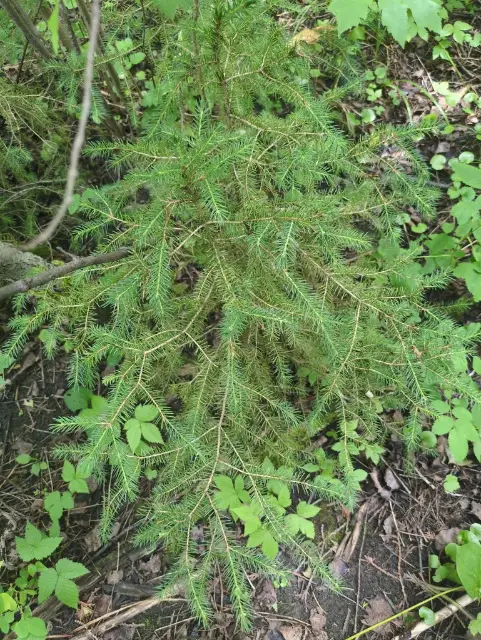
Photo: reuvenm (no rights reserved), CC0, via iNaturalist · Dymond, Temiskaming Shores, ON, Canada, 2025-07-05

Trees · Native to Quebec

White spruce

Picea glauca Pinaceae

White spruce is a cold-hardy evergreen conifer with short, stiff, blue-green needles that smell sharply aromatic when crushed. In the wild it forms a narrow cone up to 25 m tall, with slender pale brown cones held near the top of the crown. In the Flight Path Garden it grows as two cultivars: 'Pendula', a tall, narrow weeping column, and 'Conica', a slow, dense dwarf cone. Both hold their colour all winter and give the beds structure under snow.

Latin
Picea glauca
(Moench) Voss · family Pinaceae · also Picea canadensis (Mill.) Britton, Sterns & Poggenb.; Picea alba (Aiton) Link; Pinus glauca Moench
English
White spruce
Canada spruce, cat spruce, skunk spruce
French
Épinette blanche
épicéa blanc, épicéa glauque, épinette glauque
Kanien'kéha (Mohawk)
ohsó:ra onéhta
The Greenbelt survey gives this name for both white and red spruce; ohsó:ra alone is given for black spruce.
Anishinaabemowin (Ojibwe)
gaawaandag
mina'ig, gaawaandgwaatig, gaa'aandak, gawaandakook, inin'aandakook
Ojibwe People's Dictionary glosses both as 'a white spruce' (Picea glauca); both are animate nouns (na). Mina'ig is marked as a regional (BL) form.

Through the year

White spruce in every season.

Story

The history of white spruce.

White spruce is the most widely distributed spruce in the Western Hemisphere, ranging from Newfoundland and Labrador across the boreal forest to Alaska, and south to New England and the upper Great Lakes. It grows on moist upland woods, slopes and river banks, and its twigs, needles and seeds feed wildlife while its dense crown shelters nesting birds. In Quebec it is native and widespread.

The epithet glauca means bluish-grey, a reference to the waxy bloom on the needles; Conrad Moench named it Pinus glauca in 1785 and it was later moved to Picea. The tree was introduced to Britain around 1700 and is one of Canada's important timber species for pulp, paper and the soundboards of musical instruments. Spruce roots were used by Anishinaabe people for basketry, canoe lacing and cordage, and spruce gum for sealing.

Sources: Trees and Shrubs Online: Picea glauca · Lady Bird Johnson Wildflower Center: Picea glauca · VASCAN: Picea glauca · Greenbelt Indigenous Botanical Survey: White, Red and Black Spruce

'Pendula'

A weeping form with strongly pendulous branches hanging close to an upright central leader, giving a narrow, layered column of blue-green needles. It was found by Élie-Abel Carrière in Trianon Park, Versailles, France, before 1867, and was rediscovered at the Morton Arboretum in 1982, after which it spread through North American gardens.

'Conica'

Dwarf Alberta spruce, a dense, slow cone of soft bright green needles that grows about 5 to 10 cm a year and rarely produces cones. Arnold Arboretum botanists Alfred Rehder and J. G. Jack found the original seedling near Lake Laggan (Lake Louise), Alberta, in 1904 while waiting for a train, and propagated it for the trade.

Characteristics

The plant at a glance.

HeightSpecies 12 to 25 m; 'Pendula' 4 to 12 m depending on training; 'Conica' 3 to 4 m after many decades
SpreadSpecies 3 to 6 m; 'Pendula' about 1.5 to 2 m; 'Conica' 1 to 2 m
HabitNarrow conical evergreen; 'Pendula' weeping column; 'Conica' dense dwarf cone
Bloom timePollen and seed cones open in May
FlowersNo flowers; small reddish and yellowish pollen and seed cones
FoliageShort, stiff, blue-green needles with a waxy bloom, pungent when crushed
ConesSlender, pale brown cones 3 to 6 cm long, mostly near the top of the crown; 'Conica' rarely cones
HardinessZone 2
LightFull sun to light shade
MoistureMoist, well-drained; tolerates drier soil once established
Spread behaviourSingle trunk; no suckering
Native rangeNewfoundland and Labrador to Alaska, south to New England, New York and the upper Great Lakes
Quebec statusNative

In the Flight Path Garden

Where it grows here.

ZonesBack Ornamental Border · Ornamental Border, Full Sun · Ornamental Border, Partial Sun
How many4 'Pendula', 3 'Conica'
Planted2025 and 2026

In the back Ornamental Border the weeping 'Pendula' adds an evergreen vertical layer and year-round cover for birds, while the compact 'Conica' plants give the front borders a fixed winter form that never outgrows its spot.

Wildlife

Who uses it.

  • Seeds, twigs and needles are an important food for birds and small mammals, and the dense branches are valued nesting sites for birds.
  • Host plant for the caterpillars of the Columbia silkmoth (Hyalophora columbia).
  • Deer browse spruce foliage in winter when other food is scarce.

Sources: Lady Bird Johnson Wildflower Center: Picea glauca

Care

What to do, season by season.

Spring

Check 'Conica' in late spring for spider mites, which show as speckled, greyish needles on the inner branches; a hard spray of water knocks them back.

Summer

Water deeply during dry spells in the first three summers. Keep the trunk area mulched and free of turf.

Fall

Water well before freeze-up so the needles enter winter fully hydrated. Stake 'Pendula' leaders if you want it to keep gaining height.

Winter

Keep plants away from road salt spray, which spruces tolerate poorly. Brush heavy wet snow off 'Conica' so it does not split open.

Relations

Knowledge and use.

The Greenbelt Indigenous Botanical Survey records that spruce roots were and are used among Anishinaabe people for basketry, canoe lacing and other cordage, as described by Ojibwe ethnobotanist Scott Herron, who also noted the use of spruce resin as a sealant. Alyssa General of Six Nations of the Grand River is quoted there on the value of spruce gum.

Source: Greenbelt Indigenous Botanical Survey: White, Red and Black Spruce