Dorval and the West Island · Tiohtià:ke
Eco de l’OuestLow-mow lawns and eco gardens Book a consult
← All plants
Rudbeckia hirta

Photo: Andrew Sebastian, CC BY 4.0, via iNaturalist · Algonquin Provincial Park, Madawaska, ON, CA, 2021-08-04

Flowers and groundcovers · Native to central and eastern North America; Quebec populations mostly naturalized

Rudbeckia hirta

Rudbeckia hirta Asteraceae

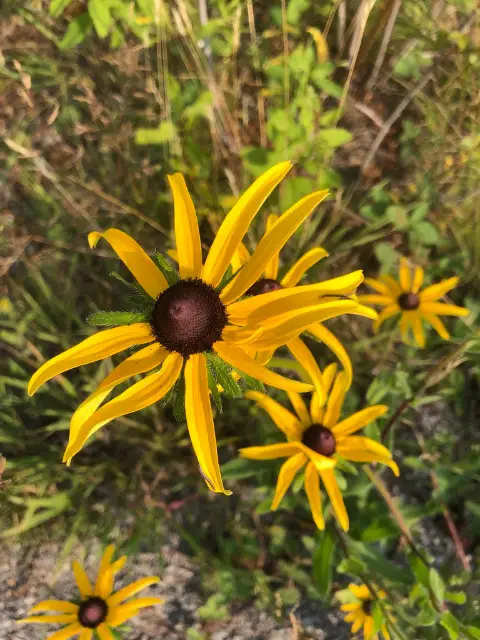
Rudbeckia hirta is an upright, hairy-stemmed plant with coarse, rough leaves and golden-yellow daisy flowers around a dark brown dome. It blooms from midsummer into autumn. It behaves as a biennial or short-lived perennial and keeps itself going by self-sowing. The dark seed heads stand through winter.

Latin
Rudbeckia hirta
L. · family Asteraceae
English
Rudbeckia hirta
hairy coneflower, gloriosa daisy
We use the botanical name instead of the common English name "black-eyed Susan", which makes light of violence against women (a black eye). See the source below for a critical review of the term.
French
Rudbeckie hérissée
marguerite jaune
Kanien'kéha (Mohawk)
Name not yet recorded
The Greenbelt Indigenous Botanical Survey species list has no Rudbeckia hirta entry, and no other citable Kanien'kéha name was found.
Anishinaabemowin (Ojibwe)
Name not yet recorded
The Ojibwe People's Dictionary search for coneflower returned no entries, and the Greenbelt survey has no Rudbeckia hirta page.

Through the year

Rudbeckia hirta in every season.

Story

The history of rudbeckia hirta.

Rudbeckia hirta is native to eastern and central North America and has naturalized widely, so it is now found in every Canadian province. In New England the typical variety is a rare native, while the common garden and roadside variety pulcherrima is considered introduced, and VASCAN's Quebec distribution for the species is computed from its varieties. It grows in fields, roadsides, open woods and clearings, and is often sown in prairie restoration and erosion-control mixes.

Linnaeus described it in 1753. The genus honours the Swedish botanist Olof Rudbeck, and hirta is Latin for hairy, for the hairs on the stems and leaves. It became Maryland's state flower in 1918. Wikipedia reports that the Ojibwe used it in poultices and infusions.

Sources: Wikipedia: Rudbeckia hirta · Go Botany: Rudbeckia hirta · VASCAN: Rudbeckia hirta · Lady Bird Johnson Wildflower Center: Rudbeckia hirta

Where it comes from

How it got to Canada.

Native rangeEastern and central North America, from western Massachusetts to Manitoba and Wyoming, south to Florida and New Mexico

The species spread across the continent with farming, seed mixes and gardens, and is now naturalized in the west and in many eastern places outside its original range. In New England the common variety pulcherrima is treated as introduced, and Quebec populations are probably largely of that kind, though VASCAN does not give a separate Quebec status for the species. No invasive listing was found for Quebec.

Sources: Go Botany: Rudbeckia hirta · Wikipedia: Rudbeckia hirta · VASCAN: Rudbeckia hirta

Characteristics

The plant at a glance.

Height30 to 90 cm
Spread30 to 45 cm
HabitUpright, branching biennial or short-lived perennial
Bloom timeJune to October
FlowersYellow rays, up to 10 cm across, around a dark brown domed cone
FoliageRough, hairy, mostly basal and alternate leaves
FruitSmall dark achenes in a cone-shaped head
HardinessZone 3
LightFull sun
MoistureDry to medium; tolerates drought
Spread behaviourSelf-sows freely
Native rangeEastern and central North America, widely naturalized
Quebec statusIntroduced, naturalized (native status in Quebec uncertain)

In the Flight Path Garden

Where it grows here.

ZonesBack Ornamental Border
How many27
Planted2023

It fills sunny beds with long-lasting yellow bloom that feeds late-season pollinators, and its self-sowing keeps colour coming back with little work.

Wildlife

Who uses it.

  • Butterflies and bees take nectar, and the plant is a larval host for the gorgone checkerspot and bordered patch butterflies.
  • Birds eat the mature seeds from the standing heads.
  • Deer resistance is rated high.

Sources: Lady Bird Johnson Wildflower Center: Rudbeckia hirta

Care

What to do, season by season.

Spring

Let self-sown seedlings come up and move extras to bare spots. Thin crowded clumps.

Summer

Water in drought for longer bloom. Afternoon shade extends flowering.

Fall

Leave some seed heads for birds and for next year's plants. Cut the rest back in late fall if preferred.

Winter

Seedlings and rosettes overwinter under snow. Remove any plants that seed where they are not wanted in spring.

Relations

Knowledge and use.

Wikipedia reports that the Ojibwe used Rudbeckia hirta as a poultice for snake bites and made infusions for colds and worms. No Kanien'kéha or Anishinaabemowin plant name was found.

Source: Wikipedia: Rudbeckia hirta