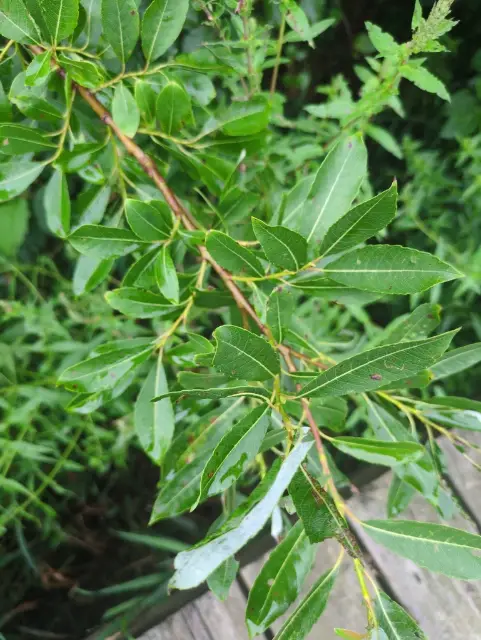
Pussy willow grows wild from Newfoundland to British Columbia and south to Virginia, Kentucky, Wyoming and Idaho, in marshy areas, stream banks and ditches. In Canada it is native from the Atlantic provinces to British Columbia and the Northwest Territories. Its early catkins give bees one of the first pollen sources of the year, and it hosts the caterpillars of several butterflies and moths, including the mourning cloak and the eastern tiger swallowtail.
The species epithet discolor refers to the two-toned leaves, green above and pale below. The cut flowering shoots are used in Eastern European Palm Sunday services as a stand-in for palm branches, which do not grow in much of North America. The willow family also contains salicin, a compound that willow bark was historically used for.