Dorval and the West Island · Tiohtià:ke
Eco de l’OuestLow-mow lawns and eco gardens Book a consult
← All plants
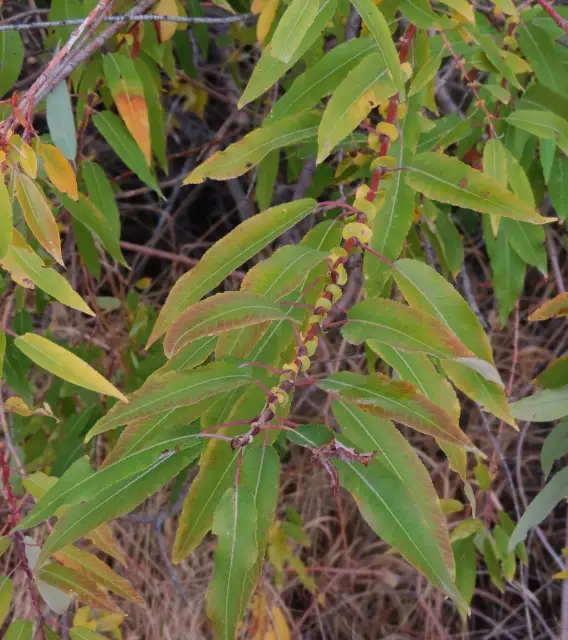
Cottony willow

Photo: dougbrown (no rights reserved), CC0, via iNaturalist · Okanagan-Similkameen, BC, Canada, 2025-10-23

Shrubs and vines · Native to Quebec

Cottony willow

Salix eriocephala Salicaceae

Cottony willow is a fast-growing, multi-stemmed shrub or small tree with dark grey, scaly bark. Its thick lance-shaped leaves are heart-shaped at the base and hairy underneath. Silky catkins appear in early spring before the leaves, and the fruit is a dry capsule that splits to release seeds. Plants grow quickly but are fairly short-lived.

Latin
Salix eriocephala
Michx. · family Salicaceae · also Salix missouriensis Bebb; Salix rigida Muhl.
English
Cottony willow
diamond willow, heart-leaved willow, Missouri River willow
French
Saule à tête laineuse
Kanien'kéha (Mohawk)
ó:se'
Genus-level: kanienkeha.org vocabulary glosses ó:se' simply as 'willow'; no species is distinguished.
Anishinaabemowin (Ojibwe)
oziisigobiminzh
Ojibwe People's Dictionary glosses oziisigobiminzh as 'a willow' (Salix spp.), an animate noun with plural oziisigobiminzhiig. It names willows in general and is not specific to this species.

Through the year

Cottony willow in every season.

Story

The history of cottony willow.

Cottony willow is found across much of temperate Canada and the United States, including Ontario and Quebec. It grows along rivers and lakeshores, in swamps, wet meadows and wetland margins, and is rated as a facultative wetland species. Its early catkins are a spring food source for insects, and it hosts the caterpillars of the mourning cloak butterfly.

The species was described by André Michaux, and the epithet eriocephala means woolly-headed, referring to the silky catkins. It is also known as Missouri River willow. Its tough, flexible branches have been used in basket weaving, and willow bark contains salicylic acid compounds related to aspirin.

Sources: VASCAN: Salix eriocephala · Wikipedia: Salix eriocephala · Go Botany: Salix eriocephala · Forward Plant: Salix eriocephala

Characteristics

The plant at a glance.

Height2 to 6 m
Spread3 to 4 m
HabitMulti-trunked shrub or small tree
Bloom timeApril to May, before the leaves
FlowersSilky catkins
FoliageThick, lance-shaped leaves 6 to 15 cm long, heart-shaped at the base and hairy underneath
FruitDry capsules that split to release seeds
HardinessHardy in zone 5a; grows wild across Quebec
LightFull sun to part shade
MoistureMoist to wet; wetland margins
Spread behaviourMulti-stemmed clump; fast growing
Native rangeMuch of temperate Canada and the United States
Quebec statusNative

In the Flight Path Garden

Where it grows here.

ZonesRain Garden #2
How many4
Planted2025

In Rain Garden #2 its thirsty roots and fast growth help soak up stormwater, and the early catkins feed insects before most other plants flower.

Wildlife

Who uses it.

  • Host plant for the caterpillars of the mourning cloak butterfly (Nymphalis antiopa).
  • Early catkins give insects food in spring before most other plants bloom.
  • Dense stems along water edges give cover to small birds and mammals.

Sources: Go Botany: Salix eriocephala · Forward Plant: Salix eriocephala

Care

What to do, season by season.

Spring

Prune out old or crowded stems right after the catkins finish to keep the clump vigorous. Cuttings of young wood root easily.

Summer

Keep the soil consistently moist in the first two summers. Mulch the root zone.

Fall

Leave the leaves to break down in place. Check stems for borer damage.

Winter

Cut back a third of the oldest stems in late winter if the plant is getting leggy. Protect young stems from rabbit and deer browse.

Relations

Knowledge and use.

The tough, flexible branches of this willow are used in basket weaving, according to a plant profile. Willows are named in Ojibwe as oziisigobiminzh in the Ojibwe People's Dictionary.

Source: Forward Plant: Salix eriocephala · Ojibwe People's Dictionary: oziisigobiminzh