Dorval and the West Island · Tiohtià:ke
Eco de l’OuestLow-mow lawns and eco gardens Book a consult
← All plants
Satiny willow

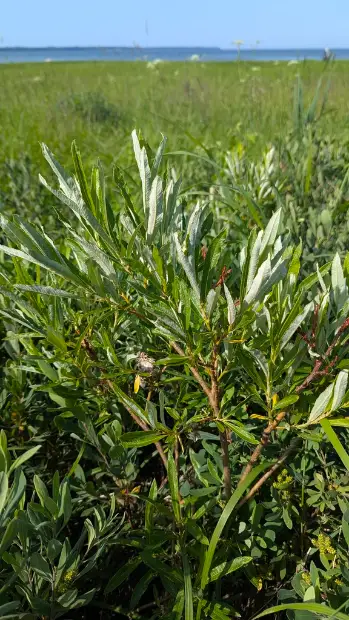
Photo: marc_aurele (no rights reserved), CC0, via iNaturalist · Rimouski, QC, Canada, 2025-07-12

Shrubs and vines · Native to Quebec

Satiny willow

Salix pellita Salicaceae

Satiny willow is a large, multi-stemmed shrub with narrow, untoothed leaves that have rolled edges and silvery, silky undersides. Its twigs are hairless with a whitish waxy coating. Male and female catkins appear on separate plants in spring before the leaves. It forms a loose, wide thicket on wet ground.

Latin
Salix pellita
(Andersson) Bebb · family Salicaceae
English
Satiny willow
silky willow, thick-leaved willow
French
Saule satiné
Kanien'kéha (Mohawk)
ó:se'
Genus-level: kanienkeha.org vocabulary glosses ó:se' simply as 'willow'; no species is distinguished.
Anishinaabemowin (Ojibwe)
oziisigobiminzh
Ojibwe People's Dictionary glosses this as 'a willow' (Salix spp.), an animate noun. It names willows in general, not Salix pellita specifically.

Through the year

Satiny willow in every season.

Story

The history of satiny willow.

Satiny willow grows on lake shores, river banks and wetland margins across northern North America, from Labrador and Quebec to Manitoba and the northern United States. It is a wetland-associated species and is rare at the southern edge of its range, for example in Minnesota, New Hampshire and Vermont. In Quebec it is native.

The species was first described by Andersson and moved to its current combination by Bebb, and the epithet pellita points to the silky covering on the leaf undersides and capsules. Willows are among the earliest plants to flower in spring, and their branches root easily when broken, which is why they are widely used in bank stabilization.

Sources: VASCAN: Salix pellita · Minnesota Wildflowers: Satiny willow · Go Botany: Salix pellita

Characteristics

The plant at a glance.

Height2.5 to 5 m
Spread2 to 4 m
HabitLarge multi-stemmed shrub, occasionally a small tree
Bloom timeApril to May, before the leaves
FlowersCatkins on separate male and female plants; male 2 to 4 cm, female 2 to 6 cm
FoliageNarrow, toothless leaves 4 to 12 cm long, rolled at the edges, silvery and silky beneath
FruitSmall silky capsules 3.5 to 6.5 mm long
HardinessZone 2
LightFull sun
MoistureMoist to wet; shorelines and stream banks
Spread behaviourMultiple stems; broken branches may root
Native rangeLabrador and Newfoundland to Manitoba, south to the northern United States
Quebec statusNative

In the Flight Path Garden

Where it grows here.

ZonesRain Garden #2
How many3
Planted2025

In Rain Garden #2 it uses wet soil and runoff, and its early catkins give pollinators food before most other shrubs bloom.

Wildlife

Who uses it.

  • The catkins open early and provide pollen and nectar for bees and other insects in spring.
  • Willows as a group host many moth and butterfly caterpillars, which in turn feed nesting birds.
  • Browsing by deer and rabbits is likely on young stems, so protect new plantings.

Sources: Minnesota Wildflowers: Satiny willow

Care

What to do, season by season.

Spring

Prune a third of the oldest stems to the ground right after flowering to keep the shrub dense. Mulch the wet-zone root area.

Summer

Water well in the first two summers if the rain garden dries out. Established plants cope with seasonal flooding.

Fall

Leave the leaf litter in place as cover for overwintering insects. Check stakes and guards on young plants before the snow.

Winter

Guard young stems against rabbit and deer browse with wire or tree wrap. Plants are fully cold-hardy.

Relations

Knowledge and use.

Nothing recorded yet from a source we can cite.