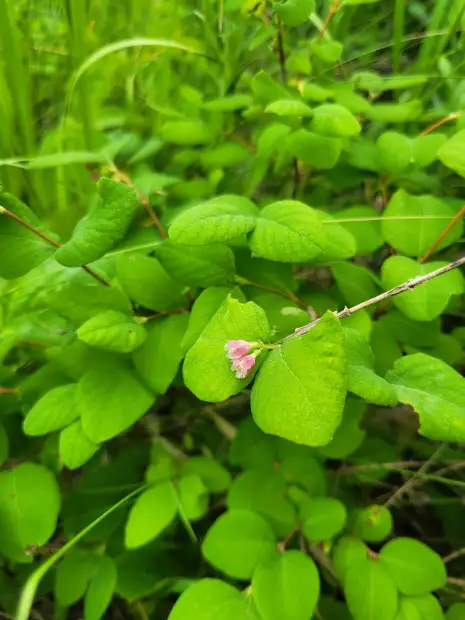
Snowberry grows across northern North America from Quebec to Alaska, scattered south to Massachusetts, Colorado and California. In the east it is a plant of open woods, forest edges, bluffs and rocky or sandy slopes, often on calcium-rich soils. It suckers from creeping rhizomes into loose colonies that hold soil on slopes, and its persistent fruit and dense twigs give food and cover to songbirds, game birds and small mammals. Two varieties are recognized: the smaller eastern var. albus and the larger western var. laevigatus, which is the form most often grown in gardens.
The genus name combines Greek words for borne together and fruit, describing the clustered berries, and albus means white. The shrub was a familiar plant of old-fashioned dooryard gardens. Its berries contain compounds that can cause mild stomach upset and are not eaten.