Dorval and the West Island · Tiohtià:ke
Eco de l’OuestLow-mow lawns and eco gardens Book a consult
← All plants
New England aster

Photo: Owen Strickland, CC BY 4.0, via iNaturalist · Tommy Thompson Park, Toronto, ON, CA, 2022-10-06

Flowers and groundcovers · Native to Quebec

New England aster

Symphyotrichum novae-angliae Asteraceae

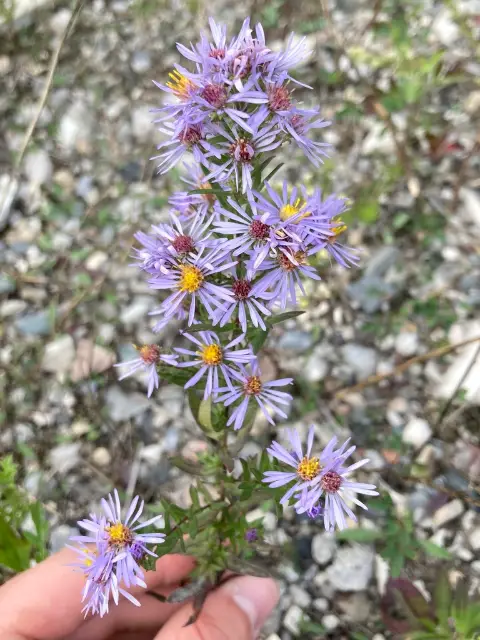
New England aster is a tall, bushy perennial with hairy, clasping leaves and branching clusters of purple to rose-pink daisy flowers with golden-yellow centres. It blooms from August into October, often the last big nectar source of the year. The centres turn reddish purple as they age. Plants spread by volunteer seedlings and can get floppy unless cut back in early summer.

Latin
Symphyotrichum novae-angliae
(L.) G.L.Nesom · family Asteraceae · also Aster novae-angliae L.; Lasallea novae-angliae; Virgulus novae-angliae
English
New England aster
Michaelmas daisy
French
Aster de Nouvelle-Angleterre
aster de la Nouvelle-Angleterre
Kanien'kéha (Mohawk)
teyonerahtawe'éhston
yotsiron’onhkóhare orón:ya
Two names given for New England aster by the Greenbelt survey.
Anishinaabemowin (Ojibwe)
waanisikensiwang
Given for New England aster by the Greenbelt survey. The Ojibwe People's Dictionary has no entry for aster.

Through the year

New England aster in every season.

Story

The history of new england aster.

This aster grows in moist meadows, marshes, prairies, stream banks and disturbed sites across central and eastern North America, from Quebec and Maine south to South Carolina and west to the Great Plains and Rocky Mountains. Late flowers feed butterflies, bees, moths and flies, and the seeds feed songbirds through fall and winter.

The genus name Symphyotrichum comes from Greek words meaning to bring together and hair, and the species name refers to New England. The English name Michaelmas daisy refers to its flowering around 29 September, Michaelmas. More than 70 cultivars exist, twelve with the Royal Horticultural Society's Award of Garden Merit, including 'Brunswick' and 'Helen Picton'.

Sources: Wikipedia: Symphyotrichum novae-angliae · Lady Bird Johnson Wildflower Center: Symphyotrichum novae-angliae · Minnesota Wildflowers: New England Aster · VASCAN: Symphyotrichum novae-angliae

Characteristics

The plant at a glance.

Height1 to 1.8 m
Spread60 to 90 cm
HabitUpright, bushy, branching clump
Bloom timeAugust to October
FlowersPurple to rose-pink rays (40 to 100) around a golden-yellow disk that darkens with age
FoliageNarrow, hairy, clasping leaves
FruitSmall seeds with fluffy hairs
HardinessZone 3
LightFull sun to part shade
MoistureMoist; tolerates average soil
Spread behaviourClumping; self-sows readily
Native rangeQuebec and Maine south to South Carolina, west to the Great Plains and Rocky Mountains
Quebec statusNative

In the Flight Path Garden

Where it grows here.

ZonesSt. Lawrence Lowlands Demonstration Garden · Meadow and Alternative Lawn Bed
How many18
Planted2026

It carries the garden's late-season bloom, giving bees and migrating monarchs nectar from August into October. Its seeds then feed birds through winter.

Wildlife

Who uses it.

  • Late nectar for native bees, bumble bees, honey bees, butterflies including monarchs, moths and flies.
  • Larval host for the pearl crescent and checkerspot butterflies.
  • Seeds feed songbirds in fall and winter.

Sources: Lady Bird Johnson Wildflower Center: Symphyotrichum novae-angliae · Minnesota Wildflowers: New England Aster

Care

What to do, season by season.

Spring

Divide crowded clumps and thin seedlings. Mulch to hold moisture.

Summer

Pinch or cut stems back by half in early June to keep plants shorter and stop flopping. Water in drought.

Fall

Leave the seedheads for birds. Collect seed if you want more plants.

Winter

Leave stems standing over winter and cut them back in early spring.

Relations

Knowledge and use.

The Greenbelt Indigenous Botanical Survey has a page for New England aster, panicled aster and bigleaf aster, but it could not be read in this session. Wikipedia notes medicinal uses by Cherokee, Iroquois and Potawatomi peoples without detailing them here.

Source: Greenbelt Indigenous Botanical Survey: New England Aster, Panicled Aster, Bigleaf Aster · Wikipedia: Symphyotrichum novae-angliae