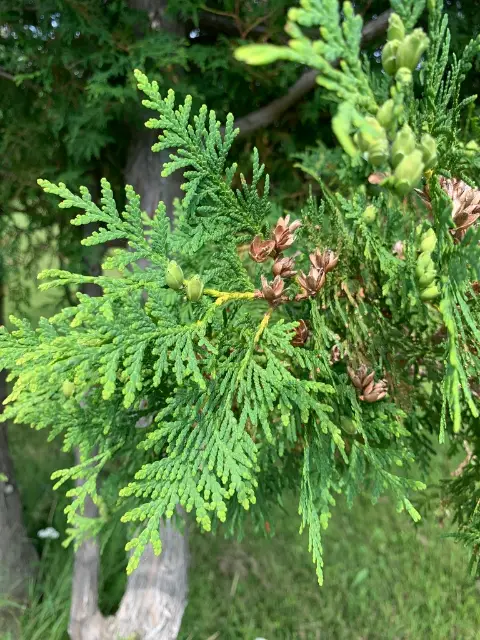
Eastern white cedar grows from southeastern Manitoba to Nova Scotia and south into the northern United States, most often in cedar swamps, on lake margins and on limestone cliffs where faster-growing trees cannot compete. It is one of the longest-lived trees in eastern North America: cedars clinging to the Niagara Escarpment in southern Ontario have been dated at more than 1,100 years. In winter its soft foliage is a staple food for white-tailed deer, and dense stands shelter deer and birds from wind and snow.
The tree is generally taken to be the annedda whose foliage tea saved Jacques Cartier's crew from scurvy at Stadacona in 1535 and 1536. It reached Europe by about 1540, among the first North American trees grown there, and its name arborvitae means tree of life in Latin. Thuja is a classical name for a resinous tree and occidentalis means western. The light, rot-resistant wood has long been used for canoe ribs and planking, fence posts, shingles and log buildings, and gardeners have selected more than 300 cultivars for hedges and screens.