Dorval and the West Island · Tiohtià:ke
Eco de l’OuestLow-mow lawns and eco gardens Book a consult
← All plants
White clover

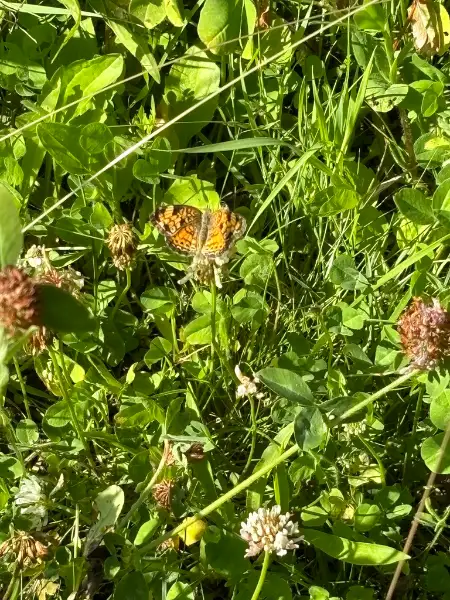
Photo: kristinpiston (no rights reserved), CC0, via iNaturalist · Highway 401 W, London, ON, CA, 2024-06-15

Flowers and groundcovers · Introduced from Europe and Central Asia

White clover

Trifolium repens Fabaceae

White clover is a low, creeping perennial with three rounded leaflets, often marked with a pale chevron, and round white flower heads 1.5 to 2 cm across. Stolons root at the nodes and knit into a dense green carpet that tolerates mowing and foot traffic. It flowers from late spring until frost. In a bee lawn it feeds pollinators and fixes nitrogen for the grass.

Latin
Trifolium repens
L. · family Fabaceae · also Trifolium saxicola Small
English
White clover
Dutch clover, Ladino clover, white Dutch clover
French
Trèfle blanc
trèfle rampant, coucou
Kanien'kéha (Mohawk)
Tionerahtó:ken katsi'tsarà:ken
Tionerahtó:ken (red clover, Trifolium pratense; NYS 4-H)
The Canadian Geographic card lists this as the Kanien'kéha name for white clover (Trifolium repens). NYS 4-H separately gives Tionerahtó:ken for red clover, so the first word looks like the clover base term; this is an observation, not a claim from either source.
Anishinaabemowin (Ojibwe)
Name not yet recorded
Not on the Greenbelt survey list, and the Ojibwe People's Dictionary search for clover returned no entries.

Through the year

White clover in every season.

Story

The history of white clover.

White clover is native to Europe and Central Asia and was brought to North America as a forage crop; it has since naturalized across grassy areas of the continent. The stolons can extend up to about 18 cm a year, and like other legumes it works with root bacteria that fix atmospheric nitrogen, typically adding 110 to 170 kg per hectare a year in pasture. It tolerates close mowing, poor soils and clay.

The genus name comes from Latin tres, three, and folium, leaf, and repens means creeping. Bumblebees and honeybees are its main visitors, which has made it a mainstay of ecological lawn mixes.

Sources: Wikipedia: Trifolium repens · VASCAN: Trifolium repens

Where it comes from

How it got to Canada.

Native rangeEurope and Central Asia

White clover was introduced to North America intentionally as a forage crop and sown widely in pastures, and it has since naturalized throughout grassy places on the continent. VASCAN lists it as introduced in Quebec, documented by Marie-Victorin in 1995. It is a common lawn and roadside plant and is sown deliberately in the Flight Path Garden's meadow bed and eco-mix lawn.

Sources: Wikipedia: Trifolium repens · VASCAN: Trifolium repens

Characteristics

The plant at a glance.

Height5 to 15 cm
SpreadSpreads by stolons, about 18 cm a year
HabitLow creeping perennial
Bloom timeMay to September
FlowersRound white to pinkish heads 1.5 to 2 cm across
FoliageThree smooth, rounded leaflets on long stalks
FruitSmall legume pods
HardinessZone 3
LightFull sun to part shade
MoistureAverage; tolerates poor soil
Spread behaviourStolons that root at nodes, plus self-sowing
Native rangeEurope and Central Asia
Quebec statusIntroduced, naturalized

In the Flight Path Garden

Where it grows here.

ZonesMeadow and Alternative Lawn Bed · St. Lawrence Lowlands Eco Mix Lawn
How manySown from seed mix
Planted2023 and 2024

In the Meadow and Alternative Lawn bed and the Eco Mix Lawn it supplies steady summer flowers for bees and fixes nitrogen so the lawn needs no fertilizer.

Wildlife

Who uses it.

  • Bumblebees and honeybees are the main pollinators of the flower heads.
  • As a legume it fixes nitrogen and so benefits neighbouring grasses.
  • Tolerates close mowing and grazing, so it works as a companion in lawns.

Sources: Wikipedia: Trifolium repens

Care

What to do, season by season.

Spring

Overseed bare patches in early spring, pressing seed lightly into soil.

Summer

Mow high (8 to 10 cm) and less often so flowers stay for bees. Water only in long drought.

Fall

Overseed thin areas in early fall and leave clippings on the lawn.

Winter

Plants die back under snow and return from the stolons in spring.

Relations

Knowledge and use.

Nothing recorded yet from a source we can cite.

Sources

Where this page comes from.

  1. VASCAN: Trifolium repens
  2. Wikipedia: Trifolium repens